Friday, June 12, 2015

Species Will: The real root of Sexism

I already show how Shame on Sex and Racism have nothing to do with Religion or Ideologies, but instead with the ubiquitous Species Will. In the following issue, some one is guessing that there is something more ancient concerning Sexism! Something that we already know what it is...

From: The Real Roots of Sexism in the Middle East (It's Not Islam, Race, or 'Hate')

Arab societies suffer from deep misogyny, but the problem is not as particularly Arab or Islamic as you might think.


Picture a woman in the Middle East, and probably the first thing that comes into your mind will be the hijab. You might not even envision a face, just the black shroud of the burqa or the niqab. Women's rights in the mostly Arab countries of the region are among the worst in the world, but it's more than that. As Egyptian-American journalist Mona Eltahawy writes in a provocative cover story for Foreign Policy, misogyny has become so endemic to Arab societies that it's not just a war on women, it's a destructive force tearing apart Arab economies and societies. But why? How did misogyny become so deeply ingrained in the Arab world?

As Maya Mikdashi once wrote, "Gender is not the study of what is evident, it is an analysis of how what is evident came to be." That's a much tougher task than cataloging the awful and often socially accepted abuses of women in the Arab world. But they both matter, and Eltahawy's lengthy article on the former might reveal more of the latter than she meant.

There are two general ways to think about the problem of misogyny in the Arab world. The first is to think of it as an Arab problem, an issue of what Arab societies and people are doing wrong. "We have no freedoms because they hate us," Eltahawy writes, the first of many times she uses "they" in a sweeping indictment of the cultures spanning from Morocco to the Arabian Peninsula. "Yes: They hate us. It must be said."

But is it really that simple? If that misogyny is so innately Arab, why is there such wide variance between Arab societies? Why did Egypt's hateful "they" elect only 2 percent women to its post-revolutionary legislature, while Tunisia's hateful "they" elected 27 percent, far short of half but still significantly more than America's 17 percent? Why are so many misogynist Arab practices as or more common in the non-Arab societies of sub-Saharan Africa or South Asia? After all, nearly every society in history has struggled with sexism, and maybe still is. Just in the U.S., for example, women could not vote until 1920; even today, their access to basic reproductive health care is backsliding. We don't think about this as an issue of American men, white men, or Christian men innately and irreducibly hating women. Why, then, should we be so ready to believe it about Arab Muslims?

A number of Arab Muslim feminists have criticized the article as reinforcing reductive, Western perceptions of Arabs as particularly and innately barbaric. Nahed Eltantawy accused the piece of representing Arab women "as the Oriental Other, weak, helpless and submissive, oppressed by Islam and the Muslim male, this ugly, barbaric monster." Samia Errazzouki fumed at "the monolithic representation of women in the region." Roqayah Chamseddine wrote, "Not only has Eltahawy demonized the men of the Middle East and confined them into one role, that of eternal tormentors, as her Western audience claps and cheers, she has not provided a way forward for these men." Dima Khatib sighed, "Arab society is not as barbaric as you present it in the article." She lamented the article as enhancing "a stereotype full of overwhelming generalizations [that] contributes to the widening cultural rift between our society and other societies, and the increase of racism towards us."

Dozens, maybe hundreds, of reports and papers compare women's rights and treatment across countries, and they all rank Arab states low on the list. But maybe not as close to the bottom as you'd think. A 2011 World Economic Forum report on national gender gaps put four Arab states in the bottom 10; the bottom 25 includes 10 Arab states, more than half of them. But sub-Saharan African countries tend to rank even more poorly. And so do South Asian societies -- where a population of nearly five times as many women as live in the Middle East endure some of the most horrific abuses in the world today. Also in 2011, Newsweek synthesized several reports and statistics on women's rights and quality of life. Their final ranking included only one Arab country in the bottom 10 (Yemen) and one more in the bottom 25 (Saudi Arabia, although we might also count Sudan). That's not to downplay the harm and severity of the problem in Arab societies, but a reminder that "misogyny" and "Arab" are not as synonymous as we sometimes treat them to be.

The other way to think about misogyny in the Arab world is as a problem of misogyny. As the above rankings show, culturally engrained sexism is not particular to Arab societies. In other words, it's a problem that Arab societies have, but it's not a distinctly Arab problem. The actual, root causes are disputed, complicated, and often controversial. But you can't cure a symptom without at least acknowledging the disease, and that disease is not race, religion, or ethnicity.

Some of the most important architects of institutionalized Arab misogyny weren't actually Arab. They were Turkish -- or, as they called themselves at the time, Ottoman -- British, and French. These foreigners ruled Arabs for centuries, twisting the cultures to accommodate their dominance. One of their favorite tricks was to buy the submission of men by offering them absolute power over women. The foreign overlords ruled the public sphere, local men ruled the private sphere, and women got nothing; academic Deniz Kandiyoti called this the "patriarchal bargain." Colonial powers employed it in the Middle East, sub-Saharan Africa, and in South Asia, promoting misogynist ideas and misogynist men who might have otherwise stayed on the margins, slowly but surely ingraining these ideas into the societies.

Of course, those first seeds of misogyny had to come from somewhere. The evolutionary explanations are controversial. Some say that it's simply because men are bigger and could fight their way to dominance; some that men seek to control women, and particularly female sexuality, out of a subconscious fear being of cuckolded and raising another man's child; others that the rise of the nation-state promoted the role of warfare in society, which meant the physically stronger gender took on more power. You don't hear these, or any of the other evolutionary theories, cited much. What you do hear cited is religion.

Like Christianity, Islam is an expansive and living religion. It has moved with the currents of history, and its billion-plus practitioners bring a wide spectrum of interpretations and beliefs. The colonial rulers who conquered Muslim societies were skilled at pulling out the slightest justification for their "patriarchal bargain." They promoted the religious leaders who were willing to take this bargain and suppressed those who objected. This is a big part of how misogynistic practices became especially common in the Muslim world (another reason is that, when the West later promoted secular rulers, anti-colonialists adopted extreme religious interpretations as a way to oppose them). "They enshrined their gentleman's agreement in the realm of the sacred by elevating their religious family laws to state laws," anthropologist Suad Joseph wrote in her 2000 book, Gender and Citizenship in the Middle East. "Women and children were the inevitable chips with which the political and religious leaders bargained." Some misogynist practices predated colonialism. But many of those, for example female genital mutilation, also predated Islam.

Arabs have endured centuries of brutal, authoritarian rule, and this could also play a role. A Western female journalist who spent years in the region, where she endured some of the region's infamous street harassment, told me that she sensed her harassers may have been acting in part out of misery, anger, and their own emasculation. Enduring the daily torments and humiliations of life under the Egyptian or Syrian or Algerian secret police, she suggested, might make an Arab man more likely to reassert his lost manhood by taking it out on women.

The intersection of race and gender is tough to discuss candidly. If we want to understand why an Egyptian man beats his wife, it's right and good to condemn him for doing it, but it's not enough. We also have to discuss the bigger forces that are guiding him, even if that makes us uncomfortable because it feels like we're excusing him. For decades, that conversation has gotten tripped up by issues of race and post-colonial relations that are always present but often too sensitive to address directly.

Spend some time in the Middle East or North Africa talking about gender and you might hear the expression, "My Arab brother before my Western sister," a warning to be quiet about injustice so as not to give the West any more excuses to condescend and dictate. The fact that feminism is broadly (and wrongly) considered a Western idea has made it tougher for proponents. After centuries of Western colonialism, bombings, invasions, and occupation, Arab men can dismiss the calls for gender equality as just another form of imposition, insisting that Arab culture does it differently. The louder our calls for gender equality get, the easier they are to wave away.

Eltahawy's personal background, unfortunately, might play a role in how some of her critics are responding. She lives mostly in the West, writes mostly for Western publications, and speaks American-accented English, all of which complicates her position and risks making her ideas seem as Westernized as she is. That's neither fair nor a reflection of the merit of her ideas, but it might inform the backlash, and it might tell us something about why the conversation she's trying to start has been stalled for so long.

The Arab Muslim women who criticized Eltahawy have been outspoken proponents of Arab feminism for years. So their backlash isn't about "Arab brother before Western sister," but it does show the extreme sensitivity about anything that could portray Arab misogyny as somehow particular to Arab society or Islam. It's not Eltahawy's job to tiptoe around Arab cultural anxieties about Western-imposed values, but the fact that her piece seems to have raised those anxieties more than it has awakened Arab male self-awareness is an important reminder that the exploitation of Arab women is about more than just gender. As some of Eltahawy's defenders have put it to me, the patriarchal societies of the Arab world need to be jolted into awareness of the harm they're doing themselves. They're right, but this article doesn't seem to have done it.

Saturday, June 6, 2015

SAMPLING: As natural as "the Death of my Little Brother"

There are those things that no Evolution will ever change. Those things, are part of Nature as physical laws. One of those things is Sampling, that means producing more data than the one is really used. So, there is a Static Logic for a Dynamic Reality, or put it simple, an Abstraction! This is also done in human activities, as abstracting things like taking many pictures to select the right ones, producing standardized items able to cope with different models, like the network cables (8P8C) in our homes with 8 wires instead of 4, twice the cooper we really need it, or in Mail routes leveled by Regional, National and International like FedEx, UPS, etc..., with those levels resulting in extended routes than the optimum ones, and also other standards in industry that make tasks simpler but wasteful.


Some people don't get this Static Logic, and make complains like:
"Why was the package routed thousand and thousands of miles instead of a few hundred? Why would the USPS, an entity with some serious financial troubles (death rattles?) go so, so far out of its way?" - in The Postal Service Shipped This Guy's Package Across the Country Twice for No Reason
Obvious answer from someone that worked in USPS:
"The system isn't designed so that your package is shipped in the most efficient manner, it's designed so the whole system is efficient. That sometimes means packages take odd routes do to space on trucks, planes, and trains. I used to work at a shipper and had a few friends in logistics, they constantly joked about some of the crazy routes packages would take because it saved the company money."
So, waste is an unavoidable thing in standardization, and so, in nature.


"Good pictures are rarely accidents. We photographers take a lot of pictures so as to get a really good one, or the best we can get from a given situation. The photos above were from a job I shot for Syracuse Media Group this past Friday." - Why Do Photographers Take So Many Pictures? 
Species, a standardization, is no exception, and has to follow this same Natural Rule. In organisms this is easily saw in the first days of life. The next stats in Yellow show exactly that, the needed waste to produce a living human organism:


But this is just a glimpse of the Species' needed waste. The romanticism of diversity, that argues that there is always a way against the odds, with arguments normally like "If ... and all of us ...", faces crude realities that no one can ignore. Like the example given before of vision problems, where there is no more or less, but only exactly what is needed (myopia), we have organs like hearts, that is to say, hearts that have to beat all the time (at least human hearts), when they fail is no diversity, is death.

Not surprisingly, death by Heart Disease is the main cause of death in Total, followed by cancer, probably because 1 in 100 born with Congenital Heart Defect (CHD). This means that to sustain a natality of 500 000 newborns without CHD you need an extra population to be wasted of 5 051, this means, 505 051! And the same goes to all the other congenital diseases combined, that accordingly to CDC represents 3%, three times more. However, if you add other diseases that aren't associated to Congenital Defects, due to undefinitions of various kinds, like the Genetics of Obesity, or due to no given diagnose like the XYY trisomy, where 88% of the males with the syndrome are never diagnosed because there are few or no problematic symptoms, or pathologies that for political reasons aren't seen as such, like homosexuality, you start to get a even bigger percentage. Then, when talking about Sexual Selection and the inherited traits that damage the sex appeal, we get a percentage of waste out of proportions.

Nevertheless, if we guess a minimum final percentage of 25% of waste probably we wont be over the real value. It can't be, says the Natural Selection fanatic! Evolution is perfect, it produces magnificent organisms...

However:
"Just one in 20 people worldwide (4·3%) had no health problems in 2013, with a third of the world's population (2·3 billion individuals) experiencing more than five ailments, according to a major new analysis." - Over 95% of the world’s population has health problems, with over a third having more than five ailments, The Lancet.
Do you understand what it means out of proportions? Do you see how Evolution has nothing to do with it? Do you get it why there is Sexual Selection? Do you grasp the Entropy and the need of Sampling?

And there is more, the actual childfree reality in USA proves exactly that. With relationships more centered in Love (Species Will) and less in resources or religious practices like before, 20% of women between 40 and 44 are childfree. But contrary to the freedom of choice lunacy, the great majority of those woman really want to have children, but they argue:
"As much as I want to be a mom, I couldn't marry a man I'm not in love with." - in The Truth About the Childless Life

This means that Species has a different view on what is an abnormality compared with medical opinion. Only the really standardized organism is a subject of Love, because Love comes from the Species Will, while organism can't escape this will, they don't love what they can't, even if they want!

But why all this waste, what is wrong with Natural Selection? Are not mutations something extremely rare, in a scale of millions of years?

If you take in consideration that the organisms that most reproduce are the ones with the best genes, and even so, the offspring those superior organisms produce is an extremely contaminated one, is difficult not to see the nature of intended waste in the Species best interest.

In order to be able to do Sampling, a Species has to have a broader population, from which is able to select the healthier snapshots, doing so in a endless fashion for each generation, maintains its share of good reproductive organisms (better genes).

Without Sampling a Species is in danger of a Genetic Bottleneck, meaning that you aren't able to select a smaller population from a population already small. So in a cyclic process, the species becomes extinct not due to lack of Diversity, but simple due to a lack of Population to do Sampling. Genetic Bottleneck normally results in fixation of deleterious genes, proving that diversity is not what species are missing.

From here, we can explain why the so called Selfish Gene didn't result in a each one by itself scenario, why people are not happy or indifferent at least with the death of distant others. And why people is so fanatic when it comes to the value of life. By other words, why religions are so fundamentalists in defending the preservation of life.

For a Selfish Gene approach based only in Natural Selection, Religion has no logic, and hardly is explained by Natural Selection, because is somehow supporting something that they don't wish to support. However if you consider that the God's Will is in reality the Species Will, you understand why the preservation of life, no matter how inferior, is needed at the eyes of any religion, and how keen it is to sell the idea of equality before God. One of the reasons is Sampling, like People on Film, where the glamorous photos are only saw after revelation. The other, I will speak in a dedicated post about DEVOTION...


Monday, May 25, 2015

Common Good: The Species Will on Individual Emancipation

The Common Good is the Cornerstone of any Society. This Common Good gives the purpose to individuals come together to achieve an Objective. In opposition, there are interests that aren't common, and in that cases compromises are required.

This Common Good with time may become less common, and more compromises are needed, what this Common Good can't be is a Corruption of the Species Will. So, a Religion or Ideology are first of all a compromise with the Species Will. Religions are the most evident and close example, they share similar views when it comes to Sexual Relationships, knowing in advance what is natural and what isn't. Reflecting which should be the place of Man and Woman. Supporting Shame when it comes to intimate relationships, or aggravating rituals to make it harder the reproduction of the Untermensch, because immorality should be avoided at all cost.

When the Common Good is no more common, when the society is rotten, the Species Will emerges as the saver from all corruption. Love becomes the new utopia, and the Natural and Virginal sexual relationship arrives to save the day. People joyfully embraces the purity of unrestrained Love, the Selvage Men embodies that ideal, free from the corruption that has been oppressing all humankind. Too bad this same people doesn't realize that are embracing the source of corruption they think are eradicating. Movies are vivid in exploring this reality, because it touches the most basic instincts of human beings. V for Vendetta, Cloud Atlas, Brazil, The Name of the Rose, THX, 1984 are just few examples.


However, not always the departure from the corrupted society is towards the Species Will. Nowadays we have a process of Emancipation of the Individual in the opposite direction. This emancipation is normally done in two steps:
  1. From Taboo to Vulgarization;
  2. From Vulgarization to Institutionalisation.
This was the process for women emancipation, legal abortion, free drugs and gay marriage. This isn't a finished reality, more excluded of the Common Good will bring their dramas like the Right to Die movement, trying to legalize Euthanasia in many countries.

Individuals have acquired many power, mainly in the first world. This power makes them apt to change and mold the Common Good, but this is just one level of a broader one. Individuals are affected by many problems, and exclusion is more a rule than an exception. Societies may be able to cope with many of these demands, but the Species Will isn't so much receptive to this kind of Vulgarism.

The Species Will isn't spread by legislation, it is the essence of mankind. This is well seen when behaviors don't match the civilized culture, the so called prejudiced thinking. Don't we live in the XXI century? Some may ask! For the Species Will there isn't such thing as XXI century. Prejudice is its instrument of regulation. "gay couple beaten" or "discrimination because i am a woman" proves exactly that, there is no legislation when it come to the Species Will.

Sooner or later, people will realize that to make Species happy they need to conform, there is no other way. The other way will imply extreme costs, that few individuals may endure.

Sooner or later, with realities being more shared, thanks to Internet and other Media, more sharp will be the differences of treatment, the individual will use all its power to correct this new perceived injustices, and increasingly more difficult will be to solve that in a convincing way due to a reality with less curtains.

Facing the striking evidences, the last trend, expectable, will be the Right to Give it Up, likewise the Right to be Forgotten.

As while as the Species Will is able to generate its Common Good, it will maintain its share of believers only destined to serve and be wasted. The problem will come when no one else wants to be one.


Friday, May 22, 2015

Eugenics - From Obligation to Voluntarism

"The woman is not attracted by the man’s face, but by his force and courage. These qualities are believed to provide the child with a vigorous protection. Women love the muscles’ vigorousness, the broad shoulders. They don’t care if the man is rude; it’s enough if he’s strong. […] Spiritual gifts do not influence sexual attraction, because they are not passed on to the child. That’s why dumb, but well built men have a better way with women than spiritual ones. There are many love unions between rude, stupid, but robust man and gentle, educated and tasteful women" - Arthur Schopenhauer
This sentence is useful, not only for what is right, but also for what is wrong. In any case, it puts the emphasis in what attract women instead of what woman want, a subtle difference that many don't see.

Obviously, the sentence that gives Schopenhauer significance is the following:
"It is not the individual, but only the species, that nature cares for. She provides for the species with boundless prodigality through the incalculable profusion of seed and the great strength of fructification. She is ever ready to let the individual fall when it has served its end of perpetuating the species. Thus does nature artlessly express the great truth that only the ideas, not the individuals, have actual reality and are complete objectivity of the will." - Arthur Schopenhauer
Well, the Schopenhauer's "Species Will to Life" is in reality just the "Species Will"! This new reality, outside the individual, that encapsulates him, and represents the ultimate Will, is the explanation of what at first seems irrational, because is not what Individual wants, but instead, what Species does.

However, as many other philosophers, Schopenhauer was also vulnerable to self interest. He was able to free himself from the ubiquitous optimism that all ways of thinking are attached to, but the reality, again, is simple too much perverse to be fully appreciated, and he, as many others, end up promoting the stereotyped image of woman in a way that best fits its interests.
"Women are directly adapted to act as the nurses and educators of our early childhood, for the simple reason that they themselves are childish, foolish, and short-sighted—in a word, are big children all their lives, something intermediate between the child and the man, who is a man in the strict sense of the word. Consider how a young girl will toy day after day with a child, dance with it and sing to it; and then consider what a man, with the very best intentions in the world, could do in her place." - Arthur Schopenhauer
As usual, truth is secondary to a cup of tea! The problem here is not very complicated, the problem is that the quest for truth is motivated by the human instinct of survival and reproduction, the Species Will, and sooner or later, when ends meet, that quest ends. To endless continue the quest for truth is required a fanatic personality, some kind of messiahs, that is willing to sacrifice the Species itself in the name of truth.

No matter how you think society must be, imposition by itself is very limited, you have to make people want what you wish them to.

Eugenics have a simple idea behind, this idea is to clean species from bad genes, avoiding carriers of those bad genes from procreating. The problem has been the lack of perception of how reality really works and the compulsory approach is simple too much limited in this purpose.

Eugenics have been supported by people like Winston Churchill, Theodore Roosevelt, John Maynard Keynes, and obviously, Adolf Hitler, some of them, switching to the new and popular view of Diversity. This is a good example how this subject is more about politics than science. As I have been writing, Diversity and Conformity have two distinct places very well defined. Diversity is promoted by Natural Selection, in the interaction between Species and Environment, while Conformity is promoted by Sexual Selection, in the interaction between Organisms and Species. This means that you as an Organism should not worry your self with Diversity, your concern is about Conformity with the Human Species, and so, the importance of Eugenics.

Nowadays, despite the view of Human Species as a wonderful species, the reproduction process, and all intrinsic results, aren't different from any other species. This means, that in essence, reproduction of a monkey leaves to chance what reproduction of a human does. So, both species may be saw as a plantation of potatoes. Potatoes aren't organisms per see (edible tuber), and artificial plantations are asexual, nevertheless, the results due to randomness gives us the idea how people is reproduced, how things are left to randomness in a uncontrollable reproduction process. Sexual Selection is like the Super Market owner, blocking the "ugly"potatoes.
 

Eugenics tries to control this randomness that systematically results in deleterious genes (diseases). In its more rude version, it targeted individuals with clear deficiencies, culminating in realities like the Hartheim Euthanasia Centre, where forced euthanasia was carried against patients in a policy of "racial hygiene". This was not more than unnecessary cruelty, because no matter what they did against disabled people, Sexual Selection is doing better. But how can you see it when your thinking is centered in Races instead of Species? Because those victims weren't just disabled in a social point of view, they were disable in a sexual one. The discrimination of Sexual Selection turns any Nazism and its Race centered view into a naïve ideology.


Despite all of this, we are all Eugenics, because that is the Species Will. What we don't want, are solutions that promise everything and deliver nothing. So, our voluntarism for Eugenics is real for technology that allow us to diagnose congenital diseases before they happened. In this way there is no need to impose death to any person when that person doesn't comes to existence in the first place.

The Will to healthy offspring is the standard Will that explains how Prenatal Screening is becoming so widespread without any blink of an eye! Concerning Genetic, and Epigenetic anomalies, thanks to the right instruments, nanotechnology, in vitro fertilization and others, Voluntarism will solve what Obligation don't.

With time, those solutions will include as anomalies a spectrum that will be many times the one we have today. With time, Voluntarism, and the perception of reality as it really is, will avoid the "Ugly" Potatoes with Diversity seen as the old and clumsy excuse for human failure!

Saturday, March 7, 2015

The myth of Diversity in a error-prone Environment

The sexual has several parameters at its disposal, in the sense that selection could mold its sexual cycle in any of several different directions (increased fusion, decreased splitting, etc.). We have seen that if damage is low there is a tradeoff between sexuality and asexuality, but that haploids generally beat the diploid due to their superior replication rates. If a sexual uses more fusion than necessary, it relinquishes its superiority to an outcome of competitive coexistence with the diploid (if the haploid is absent). In competition with the haploid, selection might eliminate a "fusion-happy, sexual, perhaps by back-mutation to a haploid in that case.
The asexual haploid cannot cope with high damage. So, when damage is high, only the sexual can compete with a diploid. The sexual cycle must maintain a minimum level of activity before the sexual can even begin to compete with the diploid. If this condition is met, then initial conditions give the outcome to one or the other of the two species or to competitive coexistence. The actual outcome is a function of initial conditions. Our computer experiments have failed to produce interesting dynamical behavior (periodic limit cycles or chaos), and we believe it unlikely that such behavior is possible in this system (for biologically reasonable parameter values) in spite of the large number of free parameters and dimensions. - in Origin of sex for error repair. I. Sex, diploidy, and haploidy.
When Entropy is systematically corrupting Species Complexity, Sexual Selection is the way to go, no other kind of reproduction is able to compete. So, so, simple!

Natural Selection (NS) vs Sexual Selection (SS)

Sexual Selection has nothing to due with Diversity, Natural Selection on Species does. Sexual Selection exists to maintain a strict connection between Species and Organisms, while Species and only Species evolves accordingly with the Environment in a way we call it Natural Selection. So, any Arms Race between forms of life doesn't differs of any other adaptation for what Natural Selection is concerned. The Red Queen Hypothesis is a complication that contradicts the reductionism that many evolutionists like to show off!

New findings show that modern humans, despite having much more population have less diversity that their ancestors. Contrary to the Red Queen Hypnotists, modern humans aren't being afflicted by any wave of parasites... Probably you need a lake of sapience!
"Paleogenomic research has shown that modern humans, Neanderthals, and their most recent common ancestor have displayed less genetic diversity than living great apes. The traditional interpretation that low levels of genetic diversity in modern humans resulted from a relatively recent demographic bottleneck cannot account for similarly low levels of genetic diversity in Middle Pleistocene hominins. A more parsimonious hypothesis proposes that the effective population size of the human lineage has been low for more than 500,000 years, but the mechanism responsible for suppressing genetic diversity in Pleistocene hominin populations without similarly affecting that of their hominoid contemporaries remains unknown. Here we use agent-based simulation to study the effect of culturally mediated migration on neutral genetic diversity in structured populations. We show that, in populations structured by culturally mediated migration, selection can suppress neutral genetic diversity over thousands of generations, even in the absence of bottlenecks or expansions in census population size. In other words, selection could have suppressed the effective population size of Pleistocene hominins for as long as the degree of cultural similarity between regionally differentiated groups played an important role in mediating intraspecific gene flow.
Modern humans display less genetic diversity than great apes, a puzzling finding given our much larger census population size (1, 2). Interestingly, recent studies have shown that modern humans are not the only hominins characterized by comparatively low levels of genetic diversity. The variability of Neanderthal mitochondrial DNA is on par with that found in modern humans (3–5). More importantly, the effective population size of the common ancestor of modern humans and Neanderthals was recently estimated at 9,999 (95% CI: 9,603–10,335)*, concurring with Noonan et al.'s (6) assumption that the effective population size of the common ancestor was similar to that of modern humans, ≈104. Why are all 3 of these Pleistocene hominin populations characterized by levels of genetic diversity that are lower than those found in extant great apes?" - Culture, population structure, and low genetic diversity in Pleistocene hominins
Puzzling? Puzzling is the degree of self delusion in the Scientific Community over the panacea of the Red Queen Hypothesis. No doubts that the modern theory centered only in Natural Selection is akin to a Religion with Genes as its God!


This idea of Diversity, is dismissed not only by the fact that all humans have virtually identical DNA, (Dr David Whitehouse, 2013), but also when no known Human Pandemic as ever ended due to Human Diversity. In the end everything counts but Diversity! Were is that Red Queen that saved us all from the Black Death or the 1918 flu pandemic? The CCR5-Δ32 Gene and its confined success against the Black Plague is the result of Natural Selection and has nothing to due with Diversity. Species was permeated by it, instead of promoting it. But if you think that this proves the necessity of Diversity in the case of a even deadly Virus or Bacteria, just have in mind that reality is not about how things should be, is about how they really are, and Species aren't about Diversity, no matter how much you wish they were! Maybe we only learn in the hard way, and history is a reminder of that...


Friday, February 27, 2015

The Ilusion of Organisms' Sexual Preferences

Despite of the gene view as the unit of selection, explanations for sexual preferences and evolution of secondary sexual traits are invariable done at the level of the Organisms' Sexual Preference, more specific, the female preference. The best example comes from the Fisher Runaway model, where a exacerbated choice of females for an ostensive trait it will promote the evolution of that trait, even when it causes prejudice in terms of ability to escape from predators, a physical disadvantage promoted by Sexual Selection.


The explanation for this handicap is that it guarantees that males with bad genes aren't able to cope with the ornament and so, to survive, the ornament is neglected signing him as a bad mate.  Here there is immediately a contradiction, calling this a non-adaptive trait despite representing a selective advantage! Clearly there is a confusion of not know for sure if it is Sexual or Natural Selection who promotes those traits. However, these confusion is more or less solved in the case of Sex Ratios, where approaches like Evolutionarily Stable Strategy (ESS) give a more Natural Selection perspective, making evident that Sexuality here makes part of the Environment that supports Natural Selection. This is even more evident when Hamilton argues that the Stable Sexual Ratio isn't necessary 1:1 as supported by Fisher. These Extraordinary Sex Ratios show that is Natural Selection and not Sexual Selection that shapes Sexual Reproduction, because the external Environment action is the main cause. With these new models more supported in math than female preferences, it's clearly the Survival of the Fittest that counts in this general Environment with or without Sexual reproduction as part of it.

Despite all this signs that point out to Species Selection, that show Natural Selection as the only force in Evolution, things like Red Queen Hypothesis continue to be supported and Sexual Selection is still seen as one source of Evolution like Natural Selection is. All this theories are captured in a very basic materialistic view, the Red Queen Hypothesizes where sex evolved because new and unfamiliar combinations of genes could be presented to parasites, preventing the parasite from preying on that organism, is a very lame justification. How can some one believe that thousand of million of yeas, that made Sexual Selection ubiquitous in all Eukaryote Species turns out to exist just to save those species from parasites? How can some one conclude that because crossing over allows endless different gene combinations it means that the purpose of Sexual Selection is diversity?

Is there a way to scape from this childish and basic way of thinking? Is there a way of center evolution where it really happens? Is there a way to understand Sexual Selection as something that restricts and controls Evolution? Is there a way to prove that Evolution is only caused by Natural Selection?

Sometimes some one is able to see further, sometimes some one points out cracks in the gene centered microevolution. In a issue entitled The counterintuitive role of sexual selection in species maintenance and speciation, is concluded that:
Using population genetic modeling techniques, we find that if allopatric populations come into contact via the onset of gene flow, sexual selection, in its purest form, takes on an inhibitory role, drastically reducing trait differentiation due to divergent local adaptation. This is due to the fact that under this Fisherian model, preferences, which are not under direct selection, equilibrate with little population differentiation, even though trait frequencies may differ greatly due to local adaptation. This creates relatively greater mating opportunities for foreign, rare males in each population, directly countering the effects of local adaptation and reducing population differentiation at a trait locus. Importantly, stronger preferences exaggerate this effect. Fisherian sexual selection is thus a double-edged sword in the development of isolation under these conditions, potentially driving differentiation in allopatry but removing it if there is contact. Ultimately its role in allopatric speciation is tenuous, failing even if contact is initiated after substantive trait and preference divergence has occurred.
Yes, macroevolution is counterintuitive, yes Species Selection is counterintuitive, yes depart from Materialism is counterintuitive, but nevertheless is the path to truth! However the idea is quite simple, crossing over in Sexual Selection is itself a departure from materialistic restrictions. Instead of Natural Selection being made on Organisms, like in prokaryotes where the genome isn't fragmented by any crossing over, with Sexual Reproduction it's made on Species, but because Species are something abstract, something Logic and not Physical, intuitively Natural Selection is seen as acting on genes, just because genes are at the Physical level! Genes are no more than the needed infrastructure to Species, they are encapsulated and maintained accordingly to the species survival to which they belong. The same way selection at the level of Organisms is limited to explain evolution in Eukaryotes, Genes are the panacea that nowadays is used to explain a more complex reality than the one materialism is able to.

The first one to contradict the gene as the Unit of Selection was Stephen Jay Gould, supporting Species Selection, become attacked by the mainstream:
John Maynard Smith, one of the world's leading evolutionary biologists, recently summarized in the NYRB the sharply conflicting assessments of Stephen Jay Gould: "Because of the excellence of his essays, he has come to be seen by non-biologists as the pre-eminent evolutionary theorist. In contrast, the evolutionary biologists with whom I have discussed his work tend to see him as a man whose ideas are so confused as to be hardly worth bothering with, but as one who should not be publicly criticized because he is at least on our side against the creationists." (NYRB, November 30, 1995, p. 46). No one can take any pleasure in the evident pain Gould is experiencing now that his actual standing within the community of professional evolutionary biologists is finally becoming more widely known. If what was a stake was solely one man's self-regard, common decency would preclude comment. But as Maynard Smith points out, more is at stake. Gould "is giving non-biologists a largely false picture of the state of evolutionary theory"—or as Ernst Mayr says of Gould and his small group of allies—they "quite conspicuously misrepresent the views of [biology's] leading spokesmen."{1}. Indeed, although Gould characterizes his critics as "anonymous" and "a tiny coterie", nearly every major evolutionary biologist of our era has weighed in a vain attempt to correct the tangle of confusions that the higher profile Gould has inundated the intellectual world with.{2} The point is not that Gould is the object of some criticism—so properly are we all—it is that his reputation as a credible and balanced authority about evolutionary biology is non-existent among those who are in a professional position to know. - http://cogweb.ucla.edu/Debate/CEP_Gould.html

However, against all this genetic fundamentalism as unit of selection, it looks like there are a lot to explore, and Species Selection turns out not to be a nonsense like the mainstream tries to make it.
Species selection in the broad sense—also termed species sorting—shapes evolutionary patterns through differences in speciation and extinction rates (and their net outcome, often termed the emergent fitness of clades) that arise by interaction of intrinsic biological traits with the environment. Effect-macroevolution occurs when those biotic traits, such as body size or fecundity, reside at the organismic level. Strict-sense species selection occurs when those traits are emergent at the species level, such as geographic range or population size. The fields of paleontology, comparative phylogenetic analysis, macroecology, and conservation biology are rich in examples of species sorting, but relatively few instances have been well documented, so the extent and efficacy of the specific processes remain poorly known. A general formalization of these processes remains challenging, but approaches drawing on hierarchical covariance models appear promising. Analyses integrating paleontological and neontological data for a single set of clades would be especially powerful. - Species Selection: Theory and Data
Terms like Organism and Species Level are clear clues to a multi layered scheme in opposition to a flat one. So, step by step, some are peeking bellow the surface, and selection by layers isn't a taboo anymore:
Does natural selection act primarily on individual organisms, on groups, on genes, or on whole species? This book provides a comprehensive analysis of the long-standing controversy in evolutionary biology over the levels of selection, focusing on conceptual, philosophical, and foundational questions. In the first half of the book, a systematic framework is developed for thinking about natural selection acting at multiple levels of the biological hierarchy; the framework is then used to help resolve outstanding issues. Considerable attention is paid to the concept of causality as it relates to the levels of selection, particularly the idea that natural selection at one hierarchical level can have effects that ‘filter’ up or down to other levels. Full account is taken of the recent biological literature on ‘major evolutionary transitions’ and the recent resurgence of interest in multi-level selection theory among biologists. Other biological topics discussed include Price's equation, kin and group selection, the gene's eye view, evolutionary game theory, selfish genetic elements, species and clade selection, and the evolution of individuality. Philosophical topics discussed include reductionism and holism, causation and correlation, the nature of hierarchical organization, and realism and pluralism about the levels of selection. - Evolution and the Levels of Selection - Samir Okasha
Step by step Species will be king in terms of Natural and Sexual Selection, while genes have been just a momentary fascination for the detail, like atoms in TVs, Cars and Refrigerants with mainstream biologists as physicists explaining the evolution of Coca Cola at the Atomic level, ignoring that Coca Cola, like Species, is selected as a whole, by the Environment of consumers.

Like Evolution centered at the Organism Level lost its veracity for Eukaryotes, so it will be at the Genes Level, because an house is not a brick, just happens to be made of it.
Most analyses of species selection require emergent, as opposed to aggregate, characters at the species level. This "emergent character" approach tends to focus on the search for adaptations at the species level. Such an approach seems to banish the most potent evolutionary property of populations--variability itself--from arguments about species selection (for variation is an aggregate character). We wish, instead, to extend the legitimate domain of species selection to aggregate characters. This extension of selection theory to the species level will concentrate, instead, on the relation between fitness and the species character, whether aggregate or emergent. Examination of the role of genetic variability in the long-term evolution of clades illustrates the cogency of broadening the definition of species selection to include aggregate characters. We reinterpret, in this light, a classic case presented in support of species selection. As originally presented, the species selection explanation of volutid neogastropod evolution was vulnerable to a counterinterpretation at the organism level. Once this case is recast within a definition of species selection that reflects the essential structure and broad applicability of hierarchical selection models, the organism-level reinterpretation of variability loses its force. We conclude that species selection on variability is a major force of macroevolution. - Species selection on variability
All turns out to be Species' Sexual Preferences!

Thursday, January 1, 2015

Why we born Racist!

The bad news about the human species is that our impulse to prejudge others predates our evolution from primates to humans, but the good news is that more recent evolution of the neocortex restrains our less noble impulses. Combining research from neuroscience and psychology, this collection of essays examines the question of whether we are born with biases based on race, gender, age, religion, and sexual orientation and whether we can learn to control ourselves and come to appreciate our differences. Contributors provide historical perspective on how science has served racism, including eugenics, and looks beyond the individual impulses to the institutional support for discrimination. The collection begins with scientists drawing on brain scans to examine the instinct toward bias and how we can mitigate those instincts and goes on to psychologists exploring the psychological roots of prejudice and highlighting tools to overcome bias without succumbing to the myth of color blindness. In the final section, social scientists ponder how we can learn through changes in cultural beliefs and social circumstances to appreciate diversity. A highly accessible, thought-provoking collection on racial bias. --Vanessa Bush on Are We Born Racist?: New Insights from Neuroscience and Positive Psychology
In the traditional biological reductionism, there are the Genes and Natural Selection that explains everything, this way math is much more imaginative than biology. This flatness makes some people to continue to search causes in the wrong place, theories that point out to some kind of "Male Warrior" in the past, that explains genes in own genome that started some kind of self defense mechanism to protect us from different races. This is an example of the "Selfish Gene" way of thinking, with the gene as the explanation for everything as the result of a flatness philosophy...

Now the truth (thanks to our Trinitarian way of thinking regarding Eukaryotes)!


The dark skin of tropical peoples is likely to be an adaptation to the strong ultraviolet (UV) radiation near the equator, perhaps protecting against sunburn or degradation of folate. By contrast, the adaptive value of light skin is questionable. In particular, the relevance of vitamin D deficiency rickets as a selective factor has been cogently criticized. Population genetic studies on the melanocortin 1 receptor (MC1R) gene (one of the genes responsible for normal human skin colour variation) also cast doubt on the role of positive natural selection in the evolution of light skin. Natural selection may favour dark skin everywhere, though to a lesser extent at higher latitudes. Darwin believed that racial differences in skin colour were caused by sexual selection. Available evidence suggests that in each society a lighter-than-average skin colour is preferred in a sexual partner. Such a preference would generate sexual selection for light skin that counteracts natural selection for dark skin. The observed latitudinal gradient in skin colour may result from the balance between natural and sexual selection. - Sexual selection as a cause of human skin colour variation: Darwin's hypothesis revisited.
Darwin, despite its oldness, was much more smart that any Dawkins of our time could ever be! In the text above it's clear the inexistence of any evolutionary advantage to whiteness, more, there are many advantages for blackness, and that makes all sense accordingly to the Eukaryotic Trinitarian Scheme. However, for a flatness fundamentalist of genes like Dawkins, this is a paradox! How can be? How the fittest genes can be the segregated ones?

As I already told, there is a systematic conflict between Natural and Sexual Selection, where the prejudice instinct is a reflect of that conflict, between the Environment and the Species reluctant to accept change, reluctant to accept blackness, Species that come from the first eukaryotes on the planet, more than 2.000 millions years ago.

In my post there are three types of genes, The Good, the Bad and the Untermensch, with the following meaning for each one:
  • the Good - Loved by Sexual Selection, he is in the Gene Pool from the beginning, he is the oldest one. Now and ever Sexual Selection has been taking care of him, is a relationship of profound love and absolute dedication that nothing can reach up;
  • the Bad - Supported by Natural Selection, he is the newcomer, an Intruder, he isn't flushed away by Sexual Selection because doesn't represent any real Entropy to be pushed away, and mainly, because Sexual Selection is permeable to Induction carry out by Natural Selection;
  • the Untermensch - The resulting waste of the Bad, its Entropy is unprompted by the Natural Selection and hated by Sexual Selection. Living in the cold with nothing to save him, is doomed to a path destined to him, a path that leads to persecution and eternal extinction, for ever and ever.  
The bad gene here, the intruder, is supported by Natural Selection, however it faces resistance of Sexual Selection, this resistance may vary accordingly to the change it produces or its success in producing a new and distinct species and not just a polymorphism.

With the start of Eukaryotes we have the real Origin of Species and their Kernels. The main priority of species is maintain the respective Kernel, however when faced with strong Natural Selection pressure Polymorphisms may arrive despite the effort of Species against them.


So, is there also a kernel for Human species? Well, if you ask which is the Skin Color for that kernel you may answer the White one. Black color come as a Polymorphism, however, to see this, you need to see the full picture, you need to see the evolution of Primates.
Chris Smith: What colour would that ancestor have been?   
Nina Jablonski: Almost certainly we can be assured that that ancestor would have probably looked a lot more like chimpanzees than us. The ancestor would have had lightly pigmented skin covered with dark hair. When you look at all higher primates including chimpanzees, the rest of the apes and Old World monkeys, all of our closest cousins—this is the pattern that we see, light skin covered by dark hair; and what’s interesting is that all of these animals have the ability to develop a tan on the exposed parts of their skin. For instance, on their faces, and on their hands, so that that ancestor probably would have had the same ability to develop a tan on the exposed areas.
Chris Smith: It’s intriguing to think that we were white, went black, and that some of us have gone white again. Why did we lose our hair though? Why didn’t we just keep the hair if that worked well for that ancestor, and stay white? - Evolution of Skin Colours - Professor Nina Jablonski, Penn State University
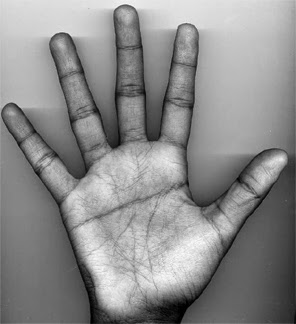
Species are all about standardization, and the Species Kernel is that Standardization! This is easily viewed in the palms hands of black people, or when they born, because all black people born white.


Because the Species Will overcomes the Organism Will, there is the need of constant repression of the Species Will to be politically correct.
Most white Americans demonstrate bias against blacks, even if they're not aware of or able to control it. It's a surprisingly little-discussed factor in the anguishing debates over race and law enforcement that followed the shootings of unarmed black men by white police officers. Such implicit biases -- which, if they were to influence split-second law enforcement decisions, could have life or death consequences -- are measured by psychological tests, most prominently the computerized Implicit Association Test, which has been taken by over two million people online at the website Project Implicit. - Across America, whites are biased and they don’t even know it
But this isn't just in America or white people, like the following videos that also show the Species Will to whiteness:


Don't recognize de difference between Prokaryotes and Eukaryotes, don't see the paper of Species manipulating its Organisms, reducing everything to Genes, is a Blindness that the Scientific community should be ashamed of.

The reason that made humans turn white again, as soon as Natural Selection loose its force (Regression not Evolution), was Sexual Selection repressing the Blackness that Species hates and Environment once loved. And because Species controls the Human Will persons are naturally racists, independently of being White or Black (same kernel). The story that says that the cause of racism is the old colonialism, is the same story that says that Shame on Sex is due to Religion. All these feelings have nothing to due with Society but all with Species.

When an Indian person is questioned why it wants to be fair, normally says it wishes to marry thinking that darkness makes it harder. So, its all about Sexual Selection.


For every place you look, you see Species Standardization, like the Sexy son hypothesis that in a nutshell means the following:
The sexy son hypothesis states that females may initially choose a trait because it improves the survival of their young, but once this preference has become widespread, females must continue to choose the trait, even if it becomes harmful. Those that do not will have sons that are unattractive to most females (since the preference is widespread) and so receive few matings - Ridley, M. 2004. Evolution. 3rd ed. Blackwell Scientific Publishing, Malden, MA. (p. 330)

The new ideology of Selfish Gene that reduces everything to genes, that ignores the fundamental difference between Prokaryotes and Eukaryotes, that nowadays is fundamentalist to the point of recognize only Natural Selection, is the biggest regressions that science has ever have.

Without the abstraction of Trinitarian Eukaryotic Scheme there will never be any good explanation for all this "human" actions, because Biology is now like Math was before, without grasping Imaginary Numbers!

Sunday, December 28, 2014

From Flatness to Trinity a depart from the Materialistic view

This is a Recap about what this Blog is about. From the multiple posts a try to call attention to the restriction of the pure materialistic view that science has today, mainly in the domain of Biology. The Richard Dawkins book The Selfish Gene is a very good example of that, is a deepening into the material, from Organisms to its Genes, never embracing nothing that isn't materialistic...

The day that this materialistic Flatness view changes to a Trinitarian one, everything will become clear, until then, questions like, why sex is so dominant in Eukaryotes, or, do Species exist, will continue to be a mystery!

So, the points that this Blog is about are the following:

1. Species are a Product of Evolution restricted to Eukaryotes

It's admitted that the origin of Eukaryotes is the biggest milestones in evolution since life exists in the planet. It's also recognized that Sexual Selection appeared shortly after the beginning of Eukaryotic life. This form of Speciation is unique, and so unique that only now we start to give the right answer about the reality of Species. Despite many skepticism that persists, you only need to search for the question "are species real?" to find many scientific articles with the absolutely right answer:
"Claridge and I agree that the entities we call species are real biological units." - Species Are Not Uniquely Real Biological Entities, Brent D. Mishler
But what it means REAL, real means real as an Organism is, it means that despite not being material it exists and exerts power and control in a way that no Organism ever could. Well, with Species Natural Selection acts no more on Organisms, it acts on this new entity we call Species. But what works on Organisms if not Natural Selection? Sexual Selection does, in a way that protects Species from deviation, allowing the existence of extremely complex organisms despite low replication fidelity, and in this sense we have the beginning of a new Scheme, the Trinitarian scheme.


You just need to recognize this to understand and have answers to questions that otherwise you will never do.

2. Species are the Physical and Psychological blueprint of its Organisms

With this new trinitarian scheme, organisms are no more than the Species infrastructure, in its relationship with the environment. So when we talk in Physical and Psychological we are always talking of Eukaryotes, as you may well know, the REALITY of psychology and species isn't applicable to Prokaryotes.

So, organisms actions, that are classified as irrational, are so because the flatness of the materialistic view, that sees only the organism self interest, and so, all rationality is centered in this materialistic organism. If you consider the Species best interests you realize that what at first sound irrational is absolutely rational, simple because Species and Organisms doesn't necessary share the same interests!

3. The Species Will overcomes the Organism Will

It's a little bit redundant this affirmation, because if something defines other something, the second one is the result not the cause. For example, if you consider that Species exist for more than 2.000 million years (Sexual Reproduction) and at the same time, Homo Sapiens Sapiens only exists for 200.000 years is easy to grasp the power ratio of 0,01%, and sure this is an overestimation, because in reality time will not change the power ratio. An infrastructure exists to be used...


4. Only Eukaryotes have Species, Prokaryotes don't

The actual common definition of Species haven't change and never will, because there are no Species outside Sexual Selection. So the definition of Species as a group of organisms capable of interbreeding and producing fertile offspring will remain despite all the efforts to force species into Prokaryotes.
The species concept is a recurrent controversial issue that preoccupies philosophers as well as biologists of all disciplines. Prokaryotic species concept has its own history and results from a series of empirical improvements parallel to the development of the techniques of analysis. Among the microbial taxonomists, there is general agreement that the species concept currently in use is useful, pragmatic and universally applicable within the prokaryotic world. However, this empirically designed concept is not encompassed by any of the, at least, 22 concepts described for eukaryotes. - The species concept for prokaryotes - Ramon Rosselló-Mora and Rudolf Amann
But why is so difficult to find an universal definition for species? The answer, because isn't applicable on Prokaryotes. So, so, simple!

5. Each Species has a kernel where Ring Species is a Fraud

Species are so conservative that consider the existence of Ring Species is not know how strong they are. Ring Species is a Concept that reality has been keen to refute.
Under what circumstances speciation in sexually reproducing animals can occur without geographical disjunction is still controversial. According to the ring–species model, a reproductive barrier may arise through ‘isolation by distance’ when peripheral populations of a species meet after expanding around some uninhabitable barrier. The classical example of this kind of speciation is the herring gull (Larus argentatus) complex, with a circumpolar distribution in the Northern Hemisphere. (...) Contrary to the ring–species model, we find no genetic evidence for a closure of the circumpolar ring through colonization of Europe by North American herring gulls. - The herring gull complex is not a ring species
A while back, when I said in the comments of an evolution post that there were no good “ring species,” a few readers asked me what I meant by that. “What about the salamander Ensatina eschscholtzii? Or seagulls in the genus Larus? Aren’t those good ring species?” My answer was that those had been shown not to be ring species in the classic sense, but there was still one species that might be a candidate: the greenish warbler Phylloscopus trochiloides around the Tibetan Plateau.
But now that one, too, has been struck off the list of ring species, leaving no good cases. Its removal from the class is documented in a new paper by Miguel Alcaide et al. in Nature (reference and link below), in a group headed by Darren Irwin, a professor at the University of British Columbia and including my next-door Chicago colleague Trevor Price. - There are no ring species

6. Natural and Sexual Selection are in systematic conflict where the Red Queen hypothesis is a fairy tail

Looking at the Trinitarian scheme of Eukaryotes, Natural and Sexual Selection have very different purposes. Natural Selection is the engine of evolution, promoting any mutation that reveals to be an advantage to the fitness of the Species. On the other hand, Sexual Selection purpose is to conserve the Species Kernel at all cost, even from the newcomer gene that supposedly will increase its fitness. In this way, species is forced by Natural Selection to accept the newcomer, never received by open harms.

For over a century, the paradigm has been that sex invariably increases genetic variation, despite many renowned biologists asserting that sex decreases most genetic variation. Sex is usually perceived as the source of additive genetic variance that drives eukaryotic evolution vis-à-vis adaptation and Fisher's fundamental theorem. However, evidence for sex decreasing genetic variation appears in ecology, paleontology, population genetics, and cancer biology. The common thread among many of these disciplines is that sex acts like a coarse filter, weeding out major changes, such as chromosomal rearrangements (that are almost always deleterious), but letting minor variation, such as changes at the nucleotide or gene level (that are often neutral), flow through the sexual sieve. Sex acts as a constraint on genomic and epigenetic variation, thereby limiting adaptive evolution. The diverse reasons for sex reducing genetic variation (especially at the genome level) and slowing down evolution may provide a sufficient benefit to offset the famed costs of sex.- Sex reduces genetic variation: a multidisciplinary review.

Just to finish, this trinity I talk about is not the Holly one, is just about the scheme, nevertheless, trinity is applicable for many other realities, proving its power as a tool for interpretation!

Sunday, December 14, 2014

The Trinity of Suicide and Self Preservation

Today I will give an explanation for the contradiction between Suicide and Self Preservation. It's believed that Self Preservation is the ultimate instinct of any Organism, and when suicidal, there is a Special Math that explains it!

But first, it's important to have in the baggage of thinking a Trinitarian view of reality. Trinity is more than Biology, is a Natural Concept like Evolution, so you will see it in other fields, equally applied to Species as it is to Religion and Ideology.


It's important to notice, that Religion and Ideology are synthesis of the Species Will, were Species is the crude version of itself. With time, Human need for explanations and control of their environment, Species evolved to Religion, and finally, to its ultimate state of sophistication, Ideology. However, all the virtues and vicious they have come from the same source, Species.

So, there is the believe that the ultimate goal of Organisms is Self Preservation, were Organisms are Selfish entities like their genes.
"They are in you and in me; they created us, body and mind; and their preservation is the ultimate rationale for our existence. They have come a long way, those replicators. Now they go by the name of genes, and we are their survival machines.”
― Richard Dawkins, The Selfish Gene
This book reveals an ingenious trick, because Organisms are very unpredicted for a Selfish model, he diverts attentions to Genes. The problem is that Genes and Organisms are at the same level, and so aren't the direct subject of Evolution (except in the case of Prokaryotes where there is only Natural Selection). So, if organisms are carriers of Genes, they would also have the ultimate Self Preservation objective. However there is a problem, Suicide. About it Dawkins says the following.
"The minimum requirement for a suicidal altruistic gene to be successful is that it should save more than two siblings (or children or parents), or more than four half-siblings (or uncles, aunts, nephews, nieces, grandparents, grandchildren), or more than eight first cousins, etc. Such a gene, on average, tends to live on in the bodies of enough individuals saved by the altruist to compensate for the death of the altruist itself."
It looks like for suicide to happen you need to have relatives and at the same tame be altruistic, because otherwise the math doesn't sum up! However the great majority of suicides have nothing to do with altruism, they are in reality very selfish, and normally are caused by isolation rather than a familiar environment. So, is there any Selfish Suicide that Dawkins wishes to talk about?

Restricting the usefulness of genes or its success to familiar relationships is a restriction that comes hand to hand with the Genes as the Object of Natural Selection. Genes may be favored by Natural Selection, but in Eukaryotes the ultimate object of Selection is the Species not the Gene. And so, no matter the familiar relationships, the gene will be successful as it will be the Species that encapsulates it. As in the Fisher's geometric model Genes are like a knob in the microscope where is the microscope who is adjusted to the environment not the knob! Strange that Dawkins doesn't realize that, despite Dawkins have named Fisher "the greatest biologist since Darwin". So, genes are supported by Natural Selection as its Species is, and by Sexual Selection as their Organisms are! Restricting evolution to Genes, is the same as restrict evolution to tools in a Factory, or an Organization, some tools make organizations more successful, but the success of those tools is measured by the success of its Organization not the contrary! By other words, Genes are encapsulated by Species when concerning Natural Selection.

So, there is no Selfish Gene, there is only Selfish Species, something that goes beyond any familiar relationship, and so, the so called Self Preservation is only applicable to Species. Organisms and their Genes are ultimately committed to other thing, they are committed to Conformity. An organism is prone to commit suicide if that Conformity is no possible and the resultant frustration pushes him to it, or the glory of a better conformity, were the first case is selfish and the second altruist regardless any familiar relationship.

In reality suicide is so Endemic that a news about a study of CDC concludes that:
Looking deeper into the data, though, shows a second astonishing fact that actually is surprising: just how high the gun-suicide rate really is.  The preamble to the CDC’s National Vital Statistics Reports Vol. 60, No. 3 cites firearms as one of the “four major mechanisms of injury in 2009” (the year of the survey), along with poisoning, motor vehicles, and falling.   In that year, 59.8% of all “firearm injury deaths” were suicides, and 36.7% were homicides. - in Who Knew? The Leading Cause Of Gun Death Is Suicide
So much for Self Preservation! Is this Altruism or just a big family? Organisms have no right to Self Preservation, Species and its derivatives do.

CDC: Suicide a leading cause of death - Genetic altruism is definitely very strong

If Self Preservation was the ultimate goal of Organisms, there will be no need for Anti Suicide campaigns, or extremely care to remove from the market drugs that are very lethal, like the Barbiturates, that otherwise would be sold like popcorns thanks to a big demand, the same demand you have with those who have no restrictions to them.
Medical practitioners have a relatively high rate of suicide. Death entry data for doctors who died by suicide or undetermined cause between 1979 and 1995 in England and Wales were used to compare methods used for suicide by doctors with those used by the general population. Methods used were analysed according to gender, occupational status and speciality, to assess the extent to which access to dangerous means influences the pattern of suicide. Self‐poisoning with drugs was more common in the doctors than in general population suicides (57% vs. 26.6%; OR=3.65, 95% CI 2.85–4.68), including in retired doctors. Barbiturates were the most frequent drugs used. Half of the anaesthetists who died used anaesthetic agents. Self‐cutting was also more frequently used as a method of suicide. The finding that the greater proportion of suicide deaths in doctors were by self‐poisoning may reflect the fact that doctors have ready access to drugs, and have knowledge of which drugs and doses are likely to cause death. The specific finding that a large proportion of suicides in anaesthetists involved anaesthetic agents supports this explanation. Availability of method may be a factor contributing to the relatively high suicide rate of doctors. This fact might influence clinical management of doctors who are known to be depressed or suicidal. - in Doctors who kill themselves: a study of the methods used for suicide
 So, what is the ultimate Goal for Organisms, Survival or Conformity?

There is a problem, Species don't make Conformity easy, there are all reasons not to conform and almost no reasons to do so, essentially because there is a single Optimum where all the rest is noise. At the same time Organism heritage from Species a cocktail of pseudo benign feelings pushing them to conformity that in case of failure immediately switch to pain.

Suicide when not a Species tool is a lesser evil. The problem of knowing the causes of suicide is the same as knowing the causes of Biologic Diseases, to many causes for a single consequence. So, is not what causes suicide but what avoids it. Like a Conformist Organism, everyone that is different at the eyes of the Species is a potential problem for it, and the causes of that difference may be infinite. In this way Organisms may be stressed to the point of committing suicide, and species being only concern about conformity have no problems with this side effect. Humans in special are very complex and consequently need to be very well tuned Organisms, and so, their lives must also be very well tuned to a kind of Standard Plot.

In great extent, is the divergence of this Plot that causes Suicide, as a Study shows, those who commit suicide already have a suicidal story, proving a divergence start from that Plot to a point of no return.
In a study published in the November issue of the Journal of Adolescent Health, researchers at the University of Washington surveyed 883 young adults ages 18 or 19 about previous suicide attempts and learned that 78 — close to 9% — had tried to commit suicide. - Study: 40% of Kids Who Attempt Suicide First Try in Elementary or Middle School
Also, suicide may be a species tool in the case when it directly serves its interests, and we may have Altruistic situations that surely go behind those that Dawkins talks about. This is true for Species as it is for Religions and Ideologies. Organisms, Believers and Militants are no more than the needed infrastructure for a given standard Protocol. This protocol may demand them to commit suicide, and compliance is what is expected.

From religious martyrs, to feverous fighters its what they believe that sands still, regardless any voluntarism! So, Species, Religions and Ideologies may promote Suicide given the right conditions, with the ultimate goal of their Self Preservation.


Not surprisingly, Shame is an extensively explored feeling when it comes to Suicide. Like in Sex, its sole purpose is absolute conformity, and in this respect is much more powerful than fear has ever been.

One goal to have, is making better Ideologies supported by better technologies, to avoid unnecessary cruelty, recognizing that if conformity is the ultimate human purpose it should be achieved in the most agreeable way possible. Making so, we are creating a Plot which divergence is less likely.