Showing posts with label Speciation. Show all posts

Friday, July 3, 2015

Species' Will or Will of the Species: Definition and Concept

"The sexual impulse is an instinct, and like most instincts, it represents the will of the species, which creates the delusion in individuals that they are seeking their own good when in fact they are seeking the good of the species (the continued existences of individuals of its kind)" - Historical Dictionary of Schopenhauer's Philosophy By David E. Cartwright

If you ask what is a Human Being the answer is simple, a member of the Homo Sapiens Species. An Eukaryotic organism is first of all something belonging to a Species.

Eukaryote Scheme of Natural and Sexual Selection

In the Eukaryotic universe, Species are nuclear, they aggregate all the information given by Natural Selection, working as a Proxy, they define what an Organism must be.

There are two conditions to the Existence of the Species' Will, and those two conditions are:
  1. Species are real in the same sense as Organisms are;
  2. Species are able to aggregate and control the traits of its Organisms.
For the first condition we have the following scientific support:
"Claridge and I agree that the entities we call species are real biological units." - Species Are Not Uniquely Real Biological Entities, Brent D. Mishler
The second one is about Macroevolution, where Species instead of Genes are the aggregated unit of Selection, and so:
"This extension of selection theory to the species level will concentrate, instead, on the relation between fitness and the species character, whether aggregate or emergent. Examination of the role of genetic variability in the long-term evolution of clades illustrates the cogency of broadening the definition of species selection to include aggregate characters." - Species selection on variability, E A Lloyd and S J Gould
There is a systematically confusion between Sampling and Diversity. In many situations where there is a great level of Sampling we see it called as Diversity. A good example is Football, where the richness of different races in Dream Teams is saw as an example of applied Diversity. This is wrong, because the rules of football are the same for all of them, and in this case those rules work like a Species not an Environment, where the firsts are rigid and the second in continuous changing. So, the football players are being Sexually Selected instead of Natural Selected. In this way you have the "best player" to be chosen, and this superior player needs to be obtained from the biggest population possible, because for extreme perfection you need extreme sampling. The so perceived diversity is no more than the consequence of greater population number needed to get the perfect player, already defined by the rules of football, already Specified.

Species aggregate not only the physical characteristics of an organism, as a woman or a man looks like, but also how they must behave. However, because the right organism requires great levels of Sampling, many waste is produced, many deviations of that Standard are obtained. This is wrongly misunderstood as diversity, an error that Species don't make. For species, deviations are exactly that, deviations, and the Species' Will is there to point out exactly that, in a way that many call prejudice, prejudice to the Hypocritical and Delusional Diversity.

Two heads Turtle, let's call it Diversity!

The Species' Will may be defined in the following way:
"The Species' Will is the Indirect Control of Organisms' Actions accordingly to an Equilibrium of Contradictory Emotions"
This Equilibrium produces Organisms meant to be Slaves and others meant to be Devoted. The emotion to be accepted is a very strong one, so the "superman" that everyone appreciates is accepted by a priori and so is free to discard the respective contradictory emotion to serve (others), in this way he is free to impose its own rules. In contrast, the Slave, has extreme difficulties to be accepted and so he is captive of the contradictory emotion to serve others as the price to obtain its castrated acceptance and respective allowance to survive, endless hoping and believing that better days will come! This equilibrium is many times the result of the conflict between Sexual and Natural Selection, where the equilibrium between the Will to Conform and the Will to Survive is well pictured in the suicidal tendencies of frustrated acceptance, because while Nature crafted Species to Survive at all cost, Species crafted Organisms to Conform at all cost avoiding this way any biological contamination mainly due to systematic deleterious mutations. The reality of this conflict results in the very common outcome of Suicide, making triumphant the Sexual Selection over the Natural one.

Other example of contradictory emotions, discussed in the post Why Shame on Sex, are Passion and Shame. The equilibrium for this two contradictory feelings is different for the biological superior and inferior organisms. So, while one succumbs to Passion, the other to Shame. While one is destined to sin, the other is doomed to chastity.


Other Emotions in the Species' Will are the Goodness of its nature opposed to the Corruption of Societies. This first emotion is such that is misunderstood as the God's Will, despite the respective contradiction that serves the Species. This God's Will is the pretty face of the Species' Will, a way to make it benevolent and good while in reality is pervert and crude. Religions' Priests or Species' Supermen, are well embody in Rasputin, a Saint at Sight and a Devil out of It, always taking advantage of the inferiority of others!


If the God's Will was really benevolent and good, there wouldn't be so many asking why they were abandoned, if Emotions were not contradictory, hardly someone become socially inept, and if  conformity was not the ultimate purpose of the Species' Will, Outcast would be a word without meaning.

The gene centered micro evolutionists well might insistently say that God doesn't exists, they may say all the time that Religion is nonsense, what they can't do is grasp the real source of what they despise, because that would hurts the Nature of Life that they so much appreciate. To see the full picture you need macroevolution, you need to realize the Species' Will.


Species' Will sees no Blue Blood

Friday, June 12, 2015

Species Will: The real root of Sexism

I already show how Shame on Sex and Racism have nothing to do with Religion or Ideologies, but instead with the ubiquitous Species Will. In the following issue, some one is guessing that there is something more ancient concerning Sexism! Something that we already know what it is...

From: The Real Roots of Sexism in the Middle East (It's Not Islam, Race, or 'Hate')

Arab societies suffer from deep misogyny, but the problem is not as particularly Arab or Islamic as you might think.


Picture a woman in the Middle East, and probably the first thing that comes into your mind will be the hijab. You might not even envision a face, just the black shroud of the burqa or the niqab. Women's rights in the mostly Arab countries of the region are among the worst in the world, but it's more than that. As Egyptian-American journalist Mona Eltahawy writes in a provocative cover story for Foreign Policy, misogyny has become so endemic to Arab societies that it's not just a war on women, it's a destructive force tearing apart Arab economies and societies. But why? How did misogyny become so deeply ingrained in the Arab world?

As Maya Mikdashi once wrote, "Gender is not the study of what is evident, it is an analysis of how what is evident came to be." That's a much tougher task than cataloging the awful and often socially accepted abuses of women in the Arab world. But they both matter, and Eltahawy's lengthy article on the former might reveal more of the latter than she meant.

There are two general ways to think about the problem of misogyny in the Arab world. The first is to think of it as an Arab problem, an issue of what Arab societies and people are doing wrong. "We have no freedoms because they hate us," Eltahawy writes, the first of many times she uses "they" in a sweeping indictment of the cultures spanning from Morocco to the Arabian Peninsula. "Yes: They hate us. It must be said."

But is it really that simple? If that misogyny is so innately Arab, why is there such wide variance between Arab societies? Why did Egypt's hateful "they" elect only 2 percent women to its post-revolutionary legislature, while Tunisia's hateful "they" elected 27 percent, far short of half but still significantly more than America's 17 percent? Why are so many misogynist Arab practices as or more common in the non-Arab societies of sub-Saharan Africa or South Asia? After all, nearly every society in history has struggled with sexism, and maybe still is. Just in the U.S., for example, women could not vote until 1920; even today, their access to basic reproductive health care is backsliding. We don't think about this as an issue of American men, white men, or Christian men innately and irreducibly hating women. Why, then, should we be so ready to believe it about Arab Muslims?

A number of Arab Muslim feminists have criticized the article as reinforcing reductive, Western perceptions of Arabs as particularly and innately barbaric. Nahed Eltantawy accused the piece of representing Arab women "as the Oriental Other, weak, helpless and submissive, oppressed by Islam and the Muslim male, this ugly, barbaric monster." Samia Errazzouki fumed at "the monolithic representation of women in the region." Roqayah Chamseddine wrote, "Not only has Eltahawy demonized the men of the Middle East and confined them into one role, that of eternal tormentors, as her Western audience claps and cheers, she has not provided a way forward for these men." Dima Khatib sighed, "Arab society is not as barbaric as you present it in the article." She lamented the article as enhancing "a stereotype full of overwhelming generalizations [that] contributes to the widening cultural rift between our society and other societies, and the increase of racism towards us."

Dozens, maybe hundreds, of reports and papers compare women's rights and treatment across countries, and they all rank Arab states low on the list. But maybe not as close to the bottom as you'd think. A 2011 World Economic Forum report on national gender gaps put four Arab states in the bottom 10; the bottom 25 includes 10 Arab states, more than half of them. But sub-Saharan African countries tend to rank even more poorly. And so do South Asian societies -- where a population of nearly five times as many women as live in the Middle East endure some of the most horrific abuses in the world today. Also in 2011, Newsweek synthesized several reports and statistics on women's rights and quality of life. Their final ranking included only one Arab country in the bottom 10 (Yemen) and one more in the bottom 25 (Saudi Arabia, although we might also count Sudan). That's not to downplay the harm and severity of the problem in Arab societies, but a reminder that "misogyny" and "Arab" are not as synonymous as we sometimes treat them to be.

The other way to think about misogyny in the Arab world is as a problem of misogyny. As the above rankings show, culturally engrained sexism is not particular to Arab societies. In other words, it's a problem that Arab societies have, but it's not a distinctly Arab problem. The actual, root causes are disputed, complicated, and often controversial. But you can't cure a symptom without at least acknowledging the disease, and that disease is not race, religion, or ethnicity.

Some of the most important architects of institutionalized Arab misogyny weren't actually Arab. They were Turkish -- or, as they called themselves at the time, Ottoman -- British, and French. These foreigners ruled Arabs for centuries, twisting the cultures to accommodate their dominance. One of their favorite tricks was to buy the submission of men by offering them absolute power over women. The foreign overlords ruled the public sphere, local men ruled the private sphere, and women got nothing; academic Deniz Kandiyoti called this the "patriarchal bargain." Colonial powers employed it in the Middle East, sub-Saharan Africa, and in South Asia, promoting misogynist ideas and misogynist men who might have otherwise stayed on the margins, slowly but surely ingraining these ideas into the societies.

Of course, those first seeds of misogyny had to come from somewhere. The evolutionary explanations are controversial. Some say that it's simply because men are bigger and could fight their way to dominance; some that men seek to control women, and particularly female sexuality, out of a subconscious fear being of cuckolded and raising another man's child; others that the rise of the nation-state promoted the role of warfare in society, which meant the physically stronger gender took on more power. You don't hear these, or any of the other evolutionary theories, cited much. What you do hear cited is religion.

Like Christianity, Islam is an expansive and living religion. It has moved with the currents of history, and its billion-plus practitioners bring a wide spectrum of interpretations and beliefs. The colonial rulers who conquered Muslim societies were skilled at pulling out the slightest justification for their "patriarchal bargain." They promoted the religious leaders who were willing to take this bargain and suppressed those who objected. This is a big part of how misogynistic practices became especially common in the Muslim world (another reason is that, when the West later promoted secular rulers, anti-colonialists adopted extreme religious interpretations as a way to oppose them). "They enshrined their gentleman's agreement in the realm of the sacred by elevating their religious family laws to state laws," anthropologist Suad Joseph wrote in her 2000 book, Gender and Citizenship in the Middle East. "Women and children were the inevitable chips with which the political and religious leaders bargained." Some misogynist practices predated colonialism. But many of those, for example female genital mutilation, also predated Islam.

Arabs have endured centuries of brutal, authoritarian rule, and this could also play a role. A Western female journalist who spent years in the region, where she endured some of the region's infamous street harassment, told me that she sensed her harassers may have been acting in part out of misery, anger, and their own emasculation. Enduring the daily torments and humiliations of life under the Egyptian or Syrian or Algerian secret police, she suggested, might make an Arab man more likely to reassert his lost manhood by taking it out on women.

The intersection of race and gender is tough to discuss candidly. If we want to understand why an Egyptian man beats his wife, it's right and good to condemn him for doing it, but it's not enough. We also have to discuss the bigger forces that are guiding him, even if that makes us uncomfortable because it feels like we're excusing him. For decades, that conversation has gotten tripped up by issues of race and post-colonial relations that are always present but often too sensitive to address directly.

Spend some time in the Middle East or North Africa talking about gender and you might hear the expression, "My Arab brother before my Western sister," a warning to be quiet about injustice so as not to give the West any more excuses to condescend and dictate. The fact that feminism is broadly (and wrongly) considered a Western idea has made it tougher for proponents. After centuries of Western colonialism, bombings, invasions, and occupation, Arab men can dismiss the calls for gender equality as just another form of imposition, insisting that Arab culture does it differently. The louder our calls for gender equality get, the easier they are to wave away.

Eltahawy's personal background, unfortunately, might play a role in how some of her critics are responding. She lives mostly in the West, writes mostly for Western publications, and speaks American-accented English, all of which complicates her position and risks making her ideas seem as Westernized as she is. That's neither fair nor a reflection of the merit of her ideas, but it might inform the backlash, and it might tell us something about why the conversation she's trying to start has been stalled for so long.

The Arab Muslim women who criticized Eltahawy have been outspoken proponents of Arab feminism for years. So their backlash isn't about "Arab brother before Western sister," but it does show the extreme sensitivity about anything that could portray Arab misogyny as somehow particular to Arab society or Islam. It's not Eltahawy's job to tiptoe around Arab cultural anxieties about Western-imposed values, but the fact that her piece seems to have raised those anxieties more than it has awakened Arab male self-awareness is an important reminder that the exploitation of Arab women is about more than just gender. As some of Eltahawy's defenders have put it to me, the patriarchal societies of the Arab world need to be jolted into awareness of the harm they're doing themselves. They're right, but this article doesn't seem to have done it.

Monday, May 25, 2015

Common Good: The Species Will on Individual Emancipation

The Common Good is the Cornerstone of any Society. This Common Good gives the purpose to individuals come together to achieve an Objective. In opposition, there are interests that aren't common, and in that cases compromises are required.

This Common Good with time may become less common, and more compromises are needed, what this Common Good can't be is a Corruption of the Species Will. So, a Religion or Ideology are first of all a compromise with the Species Will. Religions are the most evident and close example, they share similar views when it comes to Sexual Relationships, knowing in advance what is natural and what isn't. Reflecting which should be the place of Man and Woman. Supporting Shame when it comes to intimate relationships, or aggravating rituals to make it harder the reproduction of the Untermensch, because immorality should be avoided at all cost.

When the Common Good is no more common, when the society is rotten, the Species Will emerges as the saver from all corruption. Love becomes the new utopia, and the Natural and Virginal sexual relationship arrives to save the day. People joyfully embraces the purity of unrestrained Love, the Selvage Men embodies that ideal, free from the corruption that has been oppressing all humankind. Too bad this same people doesn't realize that are embracing the source of corruption they think are eradicating. Movies are vivid in exploring this reality, because it touches the most basic instincts of human beings. V for Vendetta, Cloud Atlas, Brazil, The Name of the Rose, THX, 1984 are just few examples.


However, not always the departure from the corrupted society is towards the Species Will. Nowadays we have a process of Emancipation of the Individual in the opposite direction. This emancipation is normally done in two steps:
  1. From Taboo to Vulgarization;
  2. From Vulgarization to Institutionalisation.
This was the process for women emancipation, legal abortion, free drugs and gay marriage. This isn't a finished reality, more excluded of the Common Good will bring their dramas like the Right to Die movement, trying to legalize Euthanasia in many countries.

Individuals have acquired many power, mainly in the first world. This power makes them apt to change and mold the Common Good, but this is just one level of a broader one. Individuals are affected by many problems, and exclusion is more a rule than an exception. Societies may be able to cope with many of these demands, but the Species Will isn't so much receptive to this kind of Vulgarism.

The Species Will isn't spread by legislation, it is the essence of mankind. This is well seen when behaviors don't match the civilized culture, the so called prejudiced thinking. Don't we live in the XXI century? Some may ask! For the Species Will there isn't such thing as XXI century. Prejudice is its instrument of regulation. "gay couple beaten" or "discrimination because i am a woman" proves exactly that, there is no legislation when it come to the Species Will.

Sooner or later, people will realize that to make Species happy they need to conform, there is no other way. The other way will imply extreme costs, that few individuals may endure.

Sooner or later, with realities being more shared, thanks to Internet and other Media, more sharp will be the differences of treatment, the individual will use all its power to correct this new perceived injustices, and increasingly more difficult will be to solve that in a convincing way due to a reality with less curtains.

Facing the striking evidences, the last trend, expectable, will be the Right to Give it Up, likewise the Right to be Forgotten.

As while as the Species Will is able to generate its Common Good, it will maintain its share of believers only destined to serve and be wasted. The problem will come when no one else wants to be one.


Saturday, August 16, 2014

Why Shame on Sex!

Shame is a feeling that has an important role in sex. Its restricting effect is many times seen as a product of humanity, not a natural thing, contrary to Sex. We see Shame being associated to Religion, Social Morals, Ideologies and Conservatism, what we never see, is Shame being associated to Sex! So, we will show that Shame on Sex it's much older than a few centuries, it has many millions years of existence in this world of Species.

As I already shown in many of my posts, Eukaryote form of life (Three Layers), in which we belong, is different from Prokaryote one (Two Layers). Also, the true place of Species are essential to understand the role of Sexuality.

 
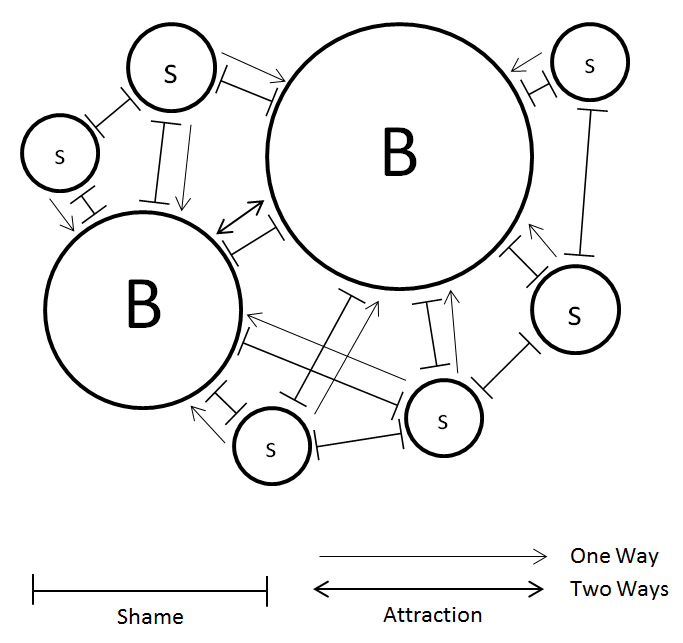
So, Sexual Selection (SS) that connects Organisms with Species, only existent in Eukaryotes, has in it two important feelings, Attraction and Shame. Attraction is a positive feeling, and Shame a negative one. In this dichotomy, attraction between organisms behave like planets formation, trough a process called Accretion!

We may use the planets formation analogy in the following way:

 
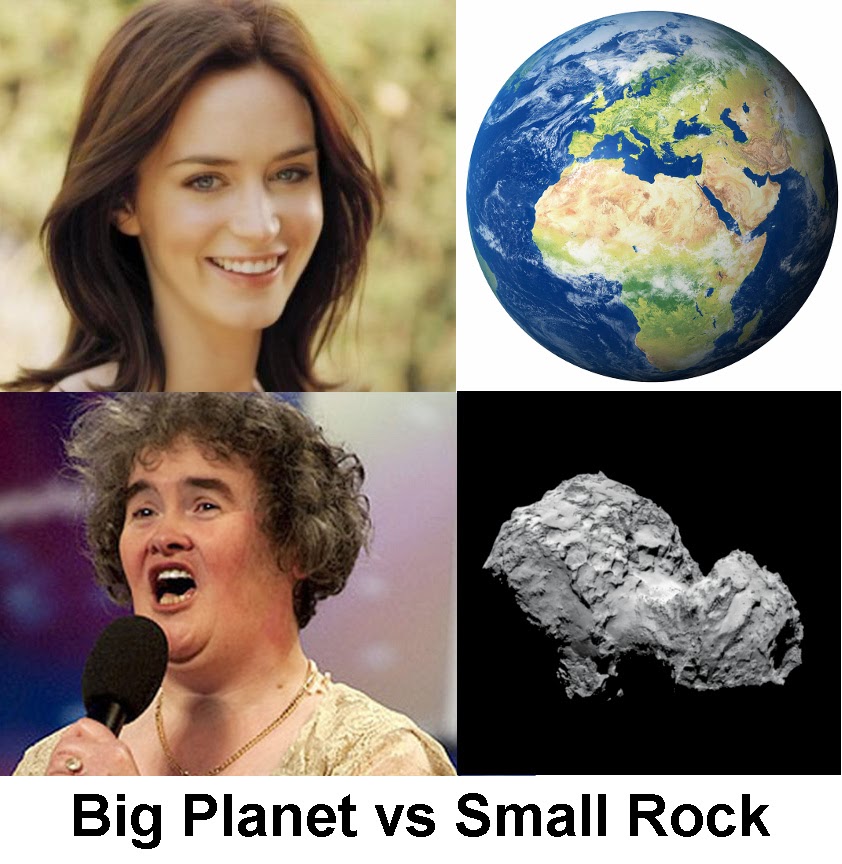
In this analogy we have Big (B) and Small (s) planets, where by the Newton's law of universal gravitation, the bigger the planets bigger is the attraction between them! So, if instead Big Planets we think in attractive organisms, we understand the logic how Sexual Selection allows the promotion of better organism in the Gene Pool. However, contrary to Planets, for Species size isn't all! For Species quality matters, because it's what defines it... In this way, Small planets shouldn't be attracted, but instead repulsed, in this way a negative feeling must be introduced. However, this feeling should be implemented in a way that doesn't interrupt the Attraction that matters to Species.

So, here we explain how each interaction must work for those two feelings:
  • Attraction:
    • Big to Big (B-B): Strong attraction due to two big Objects (Two Ways);
    • Big to Small (B-S): Medium attraction due to only one big Object (One Way);
    • Small to Small (S-S): Small or none attraction due to very low mass involved (No Way).
  • Shame:
    • Medium repulsion between any Object due to Embarrassment.

Between this two feelings there is an Equilibrium, that equilibrium works on Shame trough Natural Selection (Evolution) in a way that only Organisms with too much Entropy are wasted. One thing that is important to acknowledge is that in essence all organisms are in some degree handicapped, and the level of deficiency is strongly correlated to attractiveness, or beauty in a negative way. This is easily viewed, for instead in optics where little marge exists for error, and in some countries of Asia you have up to 80% of people with Myopia! Susan Boyle, in the Picture, suffers from Asperger syndrome proving that the prettiest is the cleanest in terms of biological Entropy. Entropy is so present, that many persons considered perfect, turn out not to be, like the well known Ricky Martin or Wentworth Miller, showing us that nothing is safe from Entropy, including sexual orientation (Not surprisingly, Species' Shame is particularly acute in this cases)! You can see more in my older posts how Consanguinity and other issues are interconnected to Sex!

However, because Shame is always present, despite Sexual dimorphism, it requires that even in the cases of Strong Attraction things had to be done in the dark to avoid Embarrassment, also with the extra advantage to species that no feeling of injustice becomes too vivid at the point that excluded Organisms don't play as expected... For Species, making Sex its own business trough Shame enforces that Organism are more operational, being worried only with terrain matters, like food and shelter, something that by itself is a good reason for Species to adopt Shame in its reproduction Scheme!

Attraction and Shame are not exclusive to Humans, despite some illuminated people that glorifies the notion that "only Humans feel", Attraction and Shame are felt in any other Animal and they worked exactly the same way with exactly the same purpose, serve its Species.


We Humans have one advantage relatively to other animals, we can solve problems inherited from nature, and instead of  bury our head in the sand, saying everything is natural, everything is cool, we may admit that a more controlled process of human reproduction is needed, acknowledge for instance that biological differences are in essence an unjust form of exclusion and not something everyone has to live with just because is something "natural" or "romantic"... More than marketing and cheap propaganda, we need to address the truth and take in our hands the reproduction mechanism, where In Vitro Fertility is a possible solution, with a increasing more efficient mechanism of diagnostic when it comes to Birth Defects! We must give to the Species what it wants and in this way put it aside from our way!

More can be done, but nothing will be if we let romantics and their ethics dominate our life with their meaningless words that are nothing more than lies serving only the Species. So, no, it's not Islam or Christianity that represses Sex and promotes Shame, is not even Communism or Fascism, is Sex itself in its Protocol implemented by their Species, where words like "Pretty" and "Ugly" are part of it!

 
But for a broader view of Shame in the Species Protocol, we may define it like:
Shame exists to ensure the conformity to the implemented If and Only If Mating Ritual (Species Protocol), while repressing everything else!
Again, Mating Rituals have nothing of romantic, they exist to serve the Species healthy, were those organisms that for some reason aren't able to play the If and Only If game are kept away due to no disrespect allowed... Disrespect to the Species Protocol of course!
 
In some way moralism is an extension of this Protocol, where its purpose is to say this is the right way, everything else is a Shame, it's immoral! And the main source of moral is no more than the actions that least shock the population, their feelings, that in reality aren't their feelings, because being ubiquitous they prove to become from only one place, Species! So this is why Shame on Sex is always present in any moral philosophy, no matter if Religious or Political, because Species aren't possible to be corrupted!


Wednesday, May 23, 2012

EVOLUTION #3 - GALILEI, AND YET IT MOVES

Galileo Galilei now seen as a revolutionary figure from the scientific point of view, it was in its time, a blasphemous that dare to say the most ridiculous thing, that earth was not in the center, but the sun instead. Nowadays, the Red Queen paradigm is the same as that centuries ago, where clamming diversity as the reason of Sexual Selection, is the same as it was, that earth doesn't move, and yet it moves!

In a not so much recent study, Synchronous Aggregate Growth in an Abundant New Ediacaran Tubular Organism, Mary L. Droser and James G. Gehling, argues to have identified the Tubes of Funisia dorothea as the first evidence of sexual reproduction. As it's put it next:
"A recent discovery made international headlines when published in Science in March 2008, announcing the discovery of the origin of sex. The paper, by Mary Droser and Jim Gehling, described a new kind of organism from the Ediacara site, which they named Funisia. Funisia was a worm-like tubular organism, the fossils of which are found abundantly at the Ediacara sites, so much so that different stages of its growth can be studied and measured in detail.

Droser and Gehling identified that these organisms were budding off ‘sprats’, or juveniles from the adults, which were all at a similar growth stage. Hence instead of shedding or budding asexually (shedding identical clones of itself), as expected for primitive organisms of this period, it is likely that the ‘sprats’ developed all at the same time due to an act that began them all: sex.

Put simply, if they were budding asexually then a wider range of sizes would be expected in the juveniles. The fact that they were always at the same size suggested an act that was timed, a mutual shedding of sperm and eggs into the water, such as occurs for corals.
" - From Cosmos

 In the Abstract of the previously referred article, it's written:
"The most abundant taxon of the Neoproterozoic soft-bodied biota near Ediacara, South Australia, occurs as clusters of similarly sized individuals, which suggests synchronous aggregate growth by spatfall. Tubes of Funisia dorothea gen. et sp. nov. were anchored within the shallow, sandy sea bed and lived in dense, typically monospecific concentrations. Tubes were composed of modular, serially repeating elements. Individuals grew by adding serial elements to the tubular body and by branching of tubes. Their construction and close-packed association imply likely affinity within the Porifera or Cnidaria. These data suggest that several of the most successful marine invertebrate ecological strategies known today were in place in Earth's oldest known metazoan ecosystems before the advent of skeletonization and widespread predation." - From Synchronous Aggregate Growth in an Abundant New Ediacaran Tubular Organism

Well, it's obvious that all this synchronous is argued as the timing, and not as the form, of Sexual Reproduction. As it's said, you simple have groups of organisms that started their growth at the same time (same size individuals). However, all the Similarity, the Clustering, and the Synchronous nature of Sexual Reproduction should ring a simple idea, that this Clustering is the true Origin of Species. And yet it clusters!


BBC - David Attenborough's First Life - See 46:16.

Sunday, January 15, 2012

EVOLUTION #2 - MENDEL, THE WHYS GUY

In this post I will materialize the importance of the Abstraction’s Environmental Process referred in the previous post. One of the ways this process become a reality is trough the chromosomal Crossing Over, as part of the Meiosis event.

In 1866, Mendel published his now famous paper entitled Experiments in Plant Hybridisation. In this time, evolutionists were attached to the blending kind of hereditary. This blending paradigm is one of the main reasons to the continuous view of evolution. Mendel, and his laws, brings a discrete and independent view of hereditary. However, in the same way only in 1900 his work was really appreciated (more than 30 years later), nowadays; the continuous view of evolution hasn’t yet been substituted by the discrete one. There are always people that simple don’t get it, and get stuck in details, in the following writing, details like not fully independent, or exotic disputes about other details, don’t change the point taken.

The Mendel laws are the base of the Hardy–Weinberg equilibrium, and because of that, this equilibrium, are only applicable to Eukaryotes and not to Prokaryotes. Now, what do you call, to the idea that all life is equally evolving, in a continuous and unstopping way like in Prokaryotes, and then, your examples are invariably involving Eukaryotes? You call it a delusion. Now, what it happens, when you ask to a deluded, if; are we still Evolving? If for the deluded, evolution is an unstoppable continuous process; he has the problem in conciliating the evolutionary force with his unstoppable and continuous concept. This difficulty makes the deluded a treasure hunter, where the treasure is the motive of the Natural Selection bias. If evolution has to be, the motive has to be found. As if it were not enough, you have the sticking species, and the respective speciation process undermining the continuous view of evolution. Now the delusion becomes denial, the denial of species’ existence, transformed in nothing more than a classification.

There is a question that until now hasn’t been well answered. What is the inbreeding effect on the genome quality? Charles Darwin was very concern with this issue, because he rightly suspected, that he and his family was victim of it. In a study entitled Was the Darwin/Wedgwood Dynasty Adversely Affected by Consanguinity?, by Tim M Berra, Gonzalo Alvarez, Francisco C Ceballos, it’s concluded that:
“(...) the high childhood mortality experienced by the Darwin progeny (...) might be a result of increased homozygosity of deleterious recessive alleles produced by the consanguineous marriages within the Darwin/Wedgwood dynasty.”

The experienced mortality wasn’t due exclusively to contagious diseases as many try to prove, but also to pure congenital ones, like the case of the last sun of Charles Darwin named Charles Waring. Many still see this as lack of diversity, as a mean to response to fast genetic change in infectious diseases. The name of this view was coined the Red Queen’s hypothesis.

Here I will give other explanation for the importance of Crossing Over, and show you that the so called arms races has nothing to do with it.

First of all, we will consider the two laws of Mendel. Those laws are:
  1. Law of Segregation – every individual possesses a pair of alleles (assuming diploidy) for any particular trait and that each parent passes a randomly selected copy (allele) of only one of these to its offspring;
  2. Law of Independent Assortment – separate genes for separate traits are passed independently of one another from parents to offspring.
Another thing to have in mind in the next simulations is that we will only consider the crossing over process in meiosis, and consequently; we will always consider haploid genomes for the sake of simplicity.

To help us to see what happens, we will construct an analogy with a picture made by pixels. In the next picture we have our Little Joe. We will consider the genes as the colors in each pixel of his picture. In this way, our analogy has the following meanings:


Original Picture of Little Joe

From the previous full picture we may zoom in to visualize each pixel.


Zoom of the original picture

Next we have the generation tree for the simulation:


Stacking tree per generation

For the first simulation, we approach the merging view of the 19th century for heritably (continuous process), staring with the creation of 16 pictures resulted from the insertion of random noise, each one with the same parameters, in the original picture (Genome) for the 1/16 generation. The first obtained picture, similar in noise to the other 15, looks like this (first arrow):


Sample 1 of 16 from the generation 1/16

For the 1/8 generation, and following the generation tree, we will evenly stack each picture of the 1/16 generation by a methodology similar to focus stacking, resulting 8 pictures with reduced noise. The first obtained picture, similar in noise to the other 7, looks like this (first one of the 1/8 generation):


Sample 1 of 8 from the generation 1/8

Repeating the process for the generation 1/4, the obtained picture, similar in noise to the other 3, looks like this (first one of the 1/4 generation):


Sample 1 of 4 from the generation 1/4

Repeating the process for the generation 1/2, the obtained picture, similar in noise to the other one, looks like this (first one of the 1/2 generation):


Sample 1 of 2 from the generation 1/2

Finally, we get a single picture for the 1/1 generation, with extremely reduced noise comparably with the one on the 1/16 generation.


Final sample from the generation 1/1

In conclusion for this first simulation, the merging process clearly has the ability to reduce noise, however, this ability tend to lose strength for each new generation. This has to do with the merging nature itself. While merging we are making averages, and as many averages we make, we never get the real color of the original picture despite the approximation to with. The maximum that the merging process can provide is an Asymptote to the original color.


Animation from generation 1/16 throughout 1/1

Now we will take a different approach. We will take for granted the species. Species in the next simulation will be represented by the original picture of the Little Joe. Species, a product of Sexual Selection, is seen here as a target of systematic bombardment made by noise. In this way, our analogy has the following added meanings:
  • Original picture – Species;
  • Mask – Threshold between positive and negative allele’s feedback;
  • Mask’s white pixel – Fixed allele;
  • Mask’s black pixel – No fixed allele.

In this simulation we drop de continuous view of the noise, and adopt a Yes or No kind one. In this way, we create a Mask for the picture where is marked if there is or isn’t noise (no fixed allele). For this mask, we use the color white for the pixel without noise, and black for the pixel with noise.

Using the first 16 pictures of the previous simulation, we produce for each one of them, the white and black mask. This mask, and the resultant picture, similar to the other 15, looks like this (first arrow):


Mask sample 1 of 16 from the generation 1/16

As you can see, this mask doesn’t represent a uniform distribution of random noise; however, because it still represents a random situation it makes no difference for this simulation.

You immediately note an important difference, now, due to this discrete approach, the noise looks like sand in a surface, it almost seems like something you may literally clean instead of dimming it.

For the staking process, we consider the product of the Mask’s pixels, so, the white pixel represents 0 and the black one 1. For each pixel we have the following stacking results:

Bellow we will review the mixed staking in more detail, for now we just accept things as they are.
Applying the stacking process, the first obtained Mask, and the resultant picture, similar in noise to the other 7, look like this (first one of the 1/8 generation):


Mask sample 1 of 8 from the generation 1/8

Repeating the process for the generation 1/4, the obtained Mask, and the resultant picture, similar in noise to the other 3, look like this (first one of the 1/4 generation):


Mask sample 1 of 4 from the generation 1/4

Repeating the process for the generation 1/2, the obtained Mask, and the resultant picture, similar in noise to the other one, look like this (first one of the 1/2 generation):


Mask sample 1 of 2 from the generation 1/2

Finally, we get a single Mask and the resultant picture for the 1/1 generation, with practically no noise comparably with the one on the 1/16 generation.


Final mask sample from the generation 1/1

Unlike the merging simulation, here there is no continuity restriction, and so, convergence can be total without any kind of Asymptote, and more importantly, there is no losing strength in reducing noise.


Animation from generation 1/16 throughout 1/1

As told before, we considered the result of a mixed stack, Heterozygous, as always White (0). You may think that it is an over simplification, however is not far from reality.

Firstly, while a no fixed allele will frequently encounter a mixed stacking (Heterozygous), a fixed allele, on the contrary, it will frequently encounter an equal allele (Homozygous), so, in terms of chances and accordingly with the first law of Mendel, a no fixed allele sees his probabilities of being carried on reduced by 1/2 per generation (Exponential decay), while the fixed one, only sporadically gets in that situation.

In top of the exponential decreasing probability, we have the Natural and Sexual Selection, each one with the following three kinds of feedback:
  1. Positive Feedback – Increases offspring relatively to the average;
  2. Neutral Feedback – Maintains offspring relatively to the average;
  3. Negative Feedback – Decreases offspring relatively to the average.
Both Negative Feedbacks, for Natural or Sexual Selection, are the last hope killers for the “lucky” noise, which one, albeit the odds managed to remain in the genome, sees its diminished odds become even more reduced next to nothing.

In conclusion, the exponential decay of the probability of fixation for a no fixed allele, associated with the negative feedbacks of Natural and Sexual Selection, is a good base to consider that the result of the crossing over between a fixed and no fixed allele is the fixed one, mainly if the no fixed one has no evolutionary advantages (noise).

However, knowing that we are considering haploid genomes, we should not view these values as exact ones. For instance, for a new allele get fixed in a population without any inbreeding, the positive feedback of Natural Evolution had to be such, to the point of canceling the Exponential decay previously referred. In this way, that positive feedback would need to produce more than 2 times the average offspring per generation, so that 2*1/2 becomes 1 (same as the fixed allele), and to compensate the initial negative feedback from Sexual Selection.

Now you may ask, but it’s not possible the existence of Positive Feedback from Sexual Selection for the newcomer allele? For the right answer, we need to realize that the positive feedback of Sexual Selection is in the direction of the existing genome that defines the species. As you saw in the last simulation, the mask is the result of the difference between the original picture and the one with the noise, and in this way, Sexual Selection is attached to a referential, something that doesn't happen with Natural Selection. So, if positive feedback for Sexual Selection is relative to an existing referential, only Natural Selection has the ability of giving Positive Feedback for newcomers.

Some of you are in this moment thinking about the peacock's tail, and making the question if that is not an excellent example of Positive Feedback of Sexual Selection for newcomers. Thirst of all, you have to have in mind that tails per se are common in birds, so tails have a Positive Feedback from Natural Selection. What we are discussing is the ornament not the tail, and the ornament may well be explained with correlation. So, if a trait, any trait, positively correlates with some other trait or traits, which have Positive Feedbacks, either from Natural or Sexual Selection, with time, and only through Natural Selection, that trait becomes a fixed trait. When it becomes a fixed trait, and only then, it may receive Positive Feedback from Sexual Selection, simply because it becomes part of the new existing referential (species). In this way, you may think in beautiful bird singing, vibrant feathers colors, and stunning flowers as exclusive products of Natural Selection.

Giving a step forward, we will approach in detail the issue of Consanguineous or Inbreeding reproduction. Since Adam and Eve times, inbreeding reproduction becomes an inevitably, however, we will not explore the Adam and Eve reality; but instead, we will try to understand what we mean by the inexistence of inbreeding, and then, its degree.

Without inbreeding, our heritage (past generations) would follow an exponential Power of Two, and after few generations, would become greater than the existent population. To visualize this reality we will use the demography evolution of Portugal expressed in the next picture.


Numeric simulation with Portuguese population

Using a generation length of 30 years, by the year of 1410 any Portuguese born after 2010 would be relative to all the Portuguese population previous to 1410! This young Portuguese would be a direct descendent of figures like the Henry the Navigator, or even his great father, John of Gaunt. In the next graphics is possible to visualize the interception point, where the population needed for a perfect non consanguineous reproduction meets the real one.


Graphical simulation with Interception point (1410)

Now that it’s clear that inbreeding is an inevitable reality, it’s time to understand its impact in the Crossing over process. More, the real question is not, what is the impact of inbreeding, but instead, what is the impact of inbreeding’s degree. For this degree we use the distance in generations. For example, in case of brothers we have 1 generation distance, in case of first cousins 2 generations, and so on. Using our generation tree, we may construct a table with the impact of consanguineous reproduction, and see the impact in terms of genetic sampling.


Generation tree considered in the simulations

In the last simulation a consanguineous reproduction can be seen as a branch removal. From the way the simulation was carry on, based on the product of the Mask’s pixels, is applicable the concept of Absorbing element, where the White (0) pixel is the Absorbing element. One of the properties associated with the Absorbing element, is that the operation order doesn’t maters, the result is the same, the absorbing element White (0). This means that the reduction of branches is equivalent to the reduction of samples. In the simulation there were 16 samples of masks, as you can see in the next picture, depending on the generation where we have inbreeding; there is a reduced new set of samples. For instance, in the case of an inbreeding in the 1/2 generation, half of the samples are removed from the equation, meaning that only 8 samples become stacked, the same effect as stopping the reproduction series in the 1/2 generation instead the 1/1.


Unremoved noise due to consanguinity

It is possible to see in the image above; that inbreeding in the generation 1/2 has an impact in the picture, maintaining some noise that otherwise would have been removed.

Other conclusion is possible to make, as you can see in the next picture, inbreeding loses its influence in an Exponential decay way as far from the 1/1 generation it occurs. For instance, a single consanguineous has an influence of 2/16 in the 1/8 generation, and an influence of 4/16 in the 1/4 generation, or in other words, the inverse of the possible number of no consanguineous mating for a given generation.


Impact of inbreeding’s degree

Consanguinity is not worldwide equally distributed, some countries, like India and Pakistan, have high rates of consanguinity. The “rat-people” is a crude example of a mal functioning cross over, something promoting fixation of alleles that otherwise would never become fixed.


Worldwide distribution of consanguineous marriages

It’s now possible to conclude that there isn’t any kind of arms race, what we have is deleterious mutations that became easily fixed due to redundant crossing over in the respective locus. These deleterious mutations, like many other symptoms, weaken the immune system to the point of being exploited by infectious diseases. They work in somehow like AIDS, making people much more likely to get infections, including opportunistic infections and tumors that do not affect people with full working immune systems.

There is another problem with the arms race of the Red Queen’s paradigm, that problem is called blood type. Blood types varies in worldwide distribution, with A blood more frequent in Europe, Australia and North America, B blood, more frequent in Asia, and O blood bore frequent in Latin America. If this is considered an arms race, you have to consider races also the result of an arms race, because the distribution of blood type isn’t very different from other racial traits, neither in time or space. In that sense, the black skin of an African person would have to be seen as an arms race against the sun. The problem is that, like in races, there aren’t significant variances in time and space to attribute to other reasons than Natural Selection. However, this arms race is still argued as the reason for Sexual Selection, something essentially different from Natural Selection.

If blood type is no more than a polymorphism, like skin color, and if blood types play an important role in the protection from infectious diseases, there is little credit to be given to Arms Race or any other thing but the old and simple Natural Selection. What you really have in constantly change that crossing over works against it, is not any kind of virus, or bacteria, it’s instead, the old and simple noise. This noise, the product of Dissipation, root of all environmental processes, undermines the complexity in life and the possibility of greater genomes. Crossing over, and the consequent Speciation, is the working solution that no Eukaryote was ever able to be truly free of.


Dependence stacking of environmental processes

So, what crossing over really is? Crossing over is the instrument of the Environmental Abstraction process. This abstraction becomes the new entity subject to evolution. With abstraction, organisms were drained of protagonism, given to the new concept of Species and its Sexual Selection mechanism. This way, species become the real subject of Natural Selection and the consequent Evolution, or simple putted, Strains gave place to Species.

If materialization was needed, you just need to remember the heritage’s Power of Two exponential process. This form of heritage, only possible with crossing over, works like a stairs that connects species with individuals; turning them, not into children of parents, but into children of species. So, for the question, what makes us human? We may simple answer, the Species does.


Stairs connecting species with individuals

In conclusion, there are those who ask how, and those who ask why, Mendel, was one of the last kind. I will end this post with a simple sentence to bear in mind.

“The HOW represses, the WHY frees.”


Prokaryotes vs. Eukaryotes, NS - Natural Selection, SS - Sexual Selection

Sunday, January 8, 2012

EVOLUTION #1 - DARWIN, THE PRIEST OF THE PRIESTS

In this post, I will try to give a new look about life, as a mere result of environmental processes, and not, as a cause of those processes that make life a glorious and almost religious thing.
 
There is one thing that many of the Evolution Priests do forget. That thing is that Evolution is just one process like many others. But because there is a need of Evolution Dissemination, processes like Selection, Mutation and Speciation are wrapped inside the Evolution process. It is possible Evolution without Mutation? No, obviously not. However, you don’t see any one spreading the word Mutation like Evolution (click for 10-fold Google results). So, we end up with the ridiculous thoughts, that Selection makes Evolution, that Mutation is part of Evolution, that Speciation is just a classification, and, consequently, that Migration is no more than a mere curiosity, without a real relationship to Speciation.

Darwin suggested as the perfect spot for the source of life, a warm little pond. Until now, many Evolutionary Priests suggested the miraculous spark for life origin. However, in a landmark discovery, chemist John Sutherland has created the conditions in which the building blocks of RNA, one of the key molecules of life and the probable precursor to DNA, assemble themselves naturally. The problem until now relates to the view of a spontaneous life generation from the ideal environment conditions, like a prebiotic soup of chemicals. If you think a little, this has to do with the view of evolution, that evolution is a product of life, and in this way, you are unable to view evolution previous to life, you are unable to see evolution as a natural process predicted by environment and completely independent of life.

The solution became simple if you get rid of the life restriction, and realize that the complex molecules necessary to life became “cooked”, by important and intermediate steps resulting in new increased complex molecules, instead a single step from a group of ingredients. However, the Evolution Priests don’t predict Evolution outside the biological world, at least in a serious way.


Revealing the Origins of Life (Jul 08, 2011)

There is another reason for this kind of Evolutionary culture. The English culture is made of sounding figures, figures that give extreme force to the Anglo Saxon view of the world. There are three particular figures that any one recognizes. Those figures are:

  1. William Shakespeare;
  2. Charles Darwin;
  3. Isaac Newton.

Albeit they being old in history, we still regard them as contemporary. It’s frequently the references to William Shakespeare in movies and other media. Charles Darwin is referred as a “know all” about evolution, and the fader of all answers in biologic world, at least in conceptual terms. And last but not least, Isaac Newton gave origin to the Apple marketing machine, the biggest Pop culture icon of our times. We may compare those with other similar figures, but with much less recognition. Those figures are:
  1. Miguel de Cervantes;
  2. August Weismann or Gregor Mendel;
  3. Gottfried Leibniz, Rudolf Clausius or Ludwig Boltzmann.
The English culture is like a species, which abstraction needs its eternal figures albeit their real significance, because the real important thing in a species is its survival, not the truth.
Now we will try to put some order in the extended expressions that are interpreted as the same, when in reality, aren’t. Using our English culture analogy, we may ask for the differences between the follow expressions:
  • England;
  • Great Britain;
  • United Kingdom;
  • Common Wealth.


The Difference between the United Kingdom, Great Britain and England Explained

For the majority, the previous expressions basically means the same, because is in the best interest of the English culture that, for instance, England means the same as Common Wealth, and so the ambiguity. Why? Because bigger is better.
The Evolution Priests are equally interested that other expressions became misunderstood with Evolution, and the common people interpret the following expressions has basically meaning the same:
  • Mutation;
  • Replication;
  • Selection;
  • Speciation;
  • Migration.
For instance, if Evolution is the product of Mutation, becomes hard to make Evolution the big deal, unless, Mutation is referred as an instrument of Evolution, and not as a distinct process.

Now we may try to interpret those processes in a distinct way, in an isolated way, and give to them a place like Evolution has. Recognizing that Environment Processes are external to life, we may figure out a layout for those Environment Processes. This layout is a rude expression of what may be, however it gives a good idea of how much it’s possible to realize thinking in distinct environmental processes.


Rude layout for Environmental Processes

Thinking in distinct environmental processes, may give you the answer for why life started only once. The Saturation process may have been triggered only shortly after the Replication one. Thinking in terms of processes you are able to make good analogies, like Internet, or Mobile Phones or even human languages. After the adoption of a particular protocol, the following Saturation makes impossible the appearance of a new one. It will be like a country enacting and replacing an official language.

To end this post, I will explain why the use of the expression Evolution Priests. To start with, I quote the Selfish Gene book of Richard Dawkins in the end of the Immortal coils chapter. He states:
It is good to get into the habit, whenever we are trying to explain the evolution of some characteristic, such as altruistic behavior, of asking ourselves simply: ‘what effect will this characteristic have on frequencies of genes in the gene pool?’” – Richard Dawkins.

Now, what is wrong with the previous quote?

In fact, nothing is.

Now, what is wrong with the next one?
It is good to get into the habit, whenever we are trying to explain the selection of some characteristic, such as altruistic behavior, of asking ourselves simply: ‘what effect will this characteristic have on frequencies of genes in the gene pool?’”

Equally nothing wrong!

We may rephrase with the words, mutation, replication, speciation, migration, and so on, that albeit a different meaning, still has nothing wrong with it.

My point is the following, surely Evolution makes part of genes and life, however, there are other processes equally important and distinct that genes depend on. And more important, in the universe of genes, not all of them have all the processes, for instance, not all life have speciation, because not all of them have greater genomes, because the speciation process has the simple effect on genes of increasing its quantity in the genome (complexity). However, for an Evolution Priest, everything becomes reduced to Evolution.

 
Genome effect of Environmental Processes